
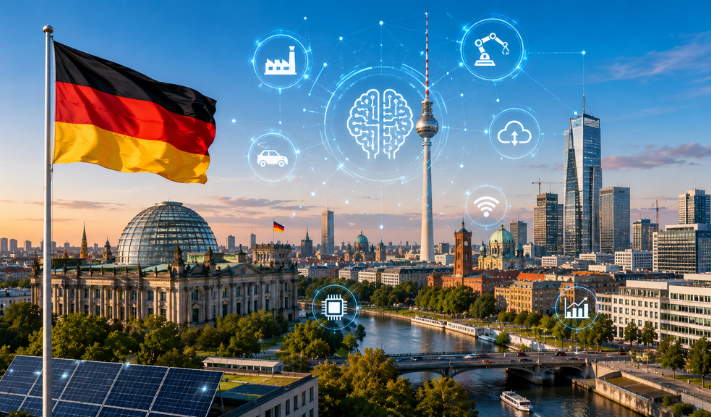
What Makes Germany a Strong Technology and AI Market?
Germany is becoming one of Europe’s most important markets for artificial intelligence (AI) and advanced technology. Its strength comes from a combination of world-class research, a powerful industrial base, skilled professionals, established technology companies, startups, advanced engineering capabilities, and growing investment in digital infrastructure.
Germany is particularly well positioned for industrial AI, where artificial intelligence is applied to manufacturing, automotive, robotics, logistics, healthcare, finance, energy, and other real-world industries.
The country’s established industrial economy gives AI companies a strong environment for developing practical solutions. But what makes Germany such a strong technology and AI market, and which industries are driving its growth?
Why Is Germany a Strong Market for AI and Technology?
Germany has several advantages that make it attractive for AI development, technology investment, and digital transformation.
The country benefits from:
- A strong manufacturing and industrial sector
- Leading universities and research institutions
- A growing AI and technology startup ecosystem
- Advanced engineering expertise
- Strong automotive and robotics industries
- Increasing investment in AI and digital infrastructure
- Government support for digital transformation
- A large business-to-business technology market
- A strong focus on responsible and trustworthy AI
Germany’s biggest advantage is its ability to connect AI with established industries. Instead of treating artificial intelligence only as a software technology, German companies are increasingly applying it to manufacturing, logistics, healthcare, mobility, energy, and business operations.
How Big Is Germany’s AI Market?
Germany’s AI market is expanding rapidly as businesses move from experimenting with artificial intelligence to implementing practical AI solutions.
Companies are increasingly using AI for data analytics, process automation, customer service, product development, forecasting, and new business models.
This growing adoption is creating opportunities for AI companies, startups, investors, technology professionals, and established enterprises.
Germany’s large industrial economy also provides a major market for companies developing AI solutions for real-world business challenges.
What Role Does Manufacturing Play in Germany’s AI Growth?
Manufacturing is one of the biggest reasons Germany is a strong AI market.
Germany has a long history of advanced manufacturing, mechanical engineering, industrial automation, and robotics. AI can build on this expertise by making factories smarter, more efficient, and increasingly automated.
Manufacturers can use AI for:
- Predictive maintenance
- Quality control
- Production optimisation
- Demand forecasting
- Industrial robotics
- Supply-chain management
- Process automation
- Energy efficiency
AI can analyse production data and identify potential equipment problems before they result in expensive downtime.
This makes AI in manufacturing particularly valuable for Germany’s industrial economy.
How Is AI Changing the German Automotive Industry?
The automotive sector is another major area of AI innovation in Germany.
Artificial intelligence can support vehicle design, manufacturing, quality control, autonomous driving technologies, supply-chain planning, predictive maintenance, and connected vehicle systems.
German automotive companies are also focusing on software-defined vehicles and advanced production technologies.
The combination of AI, robotics, sensors, cloud computing, and data analytics could make automotive production more flexible, efficient, and intelligent.
Why Is Germany Strong in AI Research?
Germany has a well-developed research ecosystem that supports both fundamental and applied AI research.
Universities and research institutions contribute to research in artificial intelligence, robotics, automation, engineering, energy, manufacturing, and other advanced technology fields.
This research environment helps connect scientific discoveries with commercial applications.
The collaboration between universities, research institutions, startups, and established companies is especially important because it can turn AI research into practical technologies and business solutions.
How Are German AI Startups Growing?
Germany’s AI startup ecosystem is becoming increasingly important.
Startups are developing artificial intelligence solutions for enterprise software, healthcare, manufacturing, transportation, cybersecurity, finance, retail, and other sectors.
Berlin and Munich are major technology and startup centres, while other German cities and regions are also developing specialised AI ecosystems.
This startup growth creates opportunities for:
- Investors
- AI professionals
- Technology companies
- Entrepreneurs
- International businesses
- Research organisations
Germany’s combination of industrial customers, technical talent, research capabilities, and investment opportunities makes it an attractive environment for AI startups.
Why Are Berlin and Munich Important for AI?
Berlin and Munich are two of Germany’s most important AI and technology hubs.
Berlin has a strong startup ecosystem supported by technology talent, investors, software companies, entrepreneurs, and innovative businesses. It is particularly attractive to emerging technology companies.
Munich has strong connections to automotive, engineering, manufacturing, research, and enterprise technology. Its industrial base provides significant opportunities for applied AI.
Other German cities and regions also contribute through universities, research centres, industrial clusters, and specialised technology companies.
How Is AI Being Used in Healthcare in Germany?
Healthcare is another important area for AI adoption in Germany.
AI can support medical imaging, diagnostics, patient management, healthcare data analysis, drug discovery, and administrative processes.
Germany’s healthcare and life sciences ecosystem provides opportunities for technology companies to develop AI solutions that help healthcare professionals analyse information and improve operational efficiency.
However, healthcare AI requires careful attention to data privacy, accuracy, safety, reliability, and human oversight.
How Is AI Being Used in Robotics and Automation in Germany?
Germany is already a major market for industrial automation, making robotics an important area for AI development.
AI-powered robots can use sensors, computer vision, machine learning, and real-time data to perform increasingly complex tasks.
These systems can be used in:
- Factories
- Warehouses
- Logistics centres
- Manufacturing facilities
- Industrial inspection
- Supply-chain operations
AI allows robots to become more flexible instead of simply repeating the same programmed instructions.
As AI and robotics advance, German companies could increasingly use intelligent machines to improve productivity and automate complex physical operations.
Why Is Digital Infrastructure Important for Germany’s AI Future?
AI requires significant computing power, cloud services, data infrastructure, high-speed connectivity, and secure digital systems.
Germany is investing in digital infrastructure, cloud computing, data centres, advanced computing, and other technologies needed to support AI development.
However, digitalisation remains an important area for further improvement.
Better connectivity, digital public services, data infrastructure, and technology adoption will be essential if Germany wants to fully benefit from the economic potential of artificial intelligence.
How Important Is Cybersecurity for Germany’s AI Market?
Cybersecurity is becoming increasingly important as German businesses become more digital and AI-powered.
AI can help organisations detect unusual behaviour, monitor networks, identify potential cyber threats, and respond to security incidents more quickly.
However, cybercriminals can also use AI to create more sophisticated attacks.
Germany therefore needs strong cybersecurity systems, secure digital infrastructure, skilled professionals, continuous monitoring, and responsible AI governance.
Why Is Responsible AI Important in Germany?
Germany places strong importance on trustworthy, transparent, and human-centred AI.
Data privacy and European AI regulations play an important role in how businesses develop and implement artificial intelligence.
Responsible AI practices can create additional compliance requirements for businesses, but they can also help build public trust and encourage safer technology adoption.
Trust will become even more important as AI expands into sensitive areas such as healthcare, finance, employment, and public services.
What Are the Biggest Challenges for AI Adoption in Germany?
Germany has strong AI capabilities, but several challenges could affect the speed of adoption.
The main challenges include:
- Digital infrastructure gaps
- Data availability and quality
- Data privacy concerns
- Shortages of specialised AI talent
- Slow technology adoption among some traditional businesses
- Regulatory complexity
- Cybersecurity risks
- Difficulty scaling AI from experiments into core business operations
Successful AI adoption requires strong data foundations, skilled employees, reliable technology infrastructure, effective governance, and organisational readiness.
Is Germany a Good Market for AI Investment?
Yes. Germany offers significant opportunities for AI investment because it combines a large industrial economy with strong research capabilities, established businesses, startups, skilled professionals, and growing demand for digital technologies.
Some of the strongest opportunities are likely to be found in:
- Manufacturing
- Automotive
- Healthcare
- Logistics
- Energy
- Finance
- Robotics
- Enterprise software
- Cybersecurity
For international companies, Germany can also provide access to the wider European technology and industrial market.
What Is the Future of AI and Technology in Germany?
The future of AI and technology in Germany is likely to focus on industrial AI, automation, robotics, enterprise software, intelligent manufacturing, healthcare technology, cybersecurity, and advanced computing.
AI will increasingly become integrated into existing business processes instead of operating as a separate technology.
Germany’s future competitiveness will depend on how effectively it combines its traditional strengths in engineering and manufacturing with AI, cloud computing, data infrastructure, software, and digital skills.
FAQs
Why is Germany good for AI?
Germany combines strong research, industrial expertise, technical talent, startups, infrastructure, and government support for AI and digitalisation.
Is Germany a leading AI country?
Yes. Germany is one of Europe’s leading AI markets, particularly in AI research, industrial applications, robotics, automation, and enterprise technology.
Which industries use AI the most in Germany?
Manufacturing, automotive, healthcare, finance, logistics, energy, robotics, and enterprise technology are among the key industries adopting AI.
Where are the AI hubs in Germany?
Berlin and Munich are major AI and technology hubs. Other cities and regions also contribute through universities, research centres, industrial clusters, and specialised technology businesses.
Is Germany a good place for AI startups?
Yes. Germany has a growing AI startup ecosystem supported by investors, research institutions, established businesses, skilled professionals, and a large B2B market.
What are Germany’s biggest AI challenges?
The main challenges include digital infrastructure, data availability, specialised talent shortages, cybersecurity, regulatory complexity, data privacy, and the difficulty of scaling AI across traditional businesses.
Is Germany a good market for AI investment?
Yes. Germany’s industrial economy, research capabilities, technology ecosystem, and growing demand for AI create opportunities for both domestic and international investors.
Conclusion
Germany is a strong technology and AI market because it combines industrial strength, research excellence, engineering expertise, technology startups, skilled talent, investment, and support for digital transformation.
Its biggest opportunity comes from combining AI with industries where Germany already has significant expertise, particularly manufacturing, automotive, robotics, healthcare, logistics, finance, and enterprise technology.
There are still challenges involving digital infrastructure, data availability, skills shortages, cybersecurity, and regulation. However, Germany has the foundations needed to remain one of Europe’s most important AI and technology markets.
The next phase of AI growth in Germany will be less about simply experimenting with artificial intelligence and more about embedding AI into real companies, factories, services, and everyday technologies.
Also Read:-
What Are the Top 10 Skincare Tips for Clear Skin?
Where Are the Best Places to Buy Real Estate in Switzerland?
How Can You Make Money Online in Russia?