
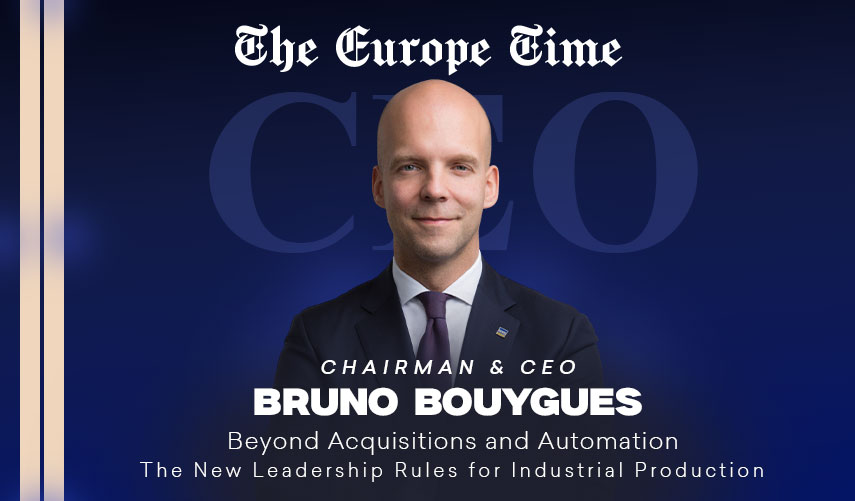
Acquisitions and lean manufacturing remain necessary but are no longer sufficient. Leaders in industrial production must also master technology, protect R&D and speed up product launches, says Bruno Bouygues, Chairman and CEO of GYS, a French manufacturer of machine tools.
What worked for thirty years?
For three decades, the performance of equipment manufacturers rested on two pillars. The first was external growth through successive acquisitions. The second was operational excellence: lean manufacturing, line automation and permanent cost compression.
Together, these pillars defined what a strong industrial leader looked like. Excellence was measured by the ability to buy market share and to hunt down the slightest cent of inefficiency in the factory. For a long time, the formula worked. It built larger, leaner and more profitable companies, and it rewarded executives who mastered finance and operations.
Why is that model running out of road?
The tools themselves are not the problem. Acquisitions and operational excellence remain necessary. The problem is that they are no longer a sufficient shield against a wave of technological change of unprecedented intensity.
Two weaknesses explain why.
- Acquisitions rarely buy a technological lead. Buying a competitor usually brings business volume, a customer portfolio and assembly capacity. All too rarely does it bring a technological advantage.
- Automation cannot rescue the wrong product. Having the most automated factory in the world is pointless if it produces machines the market already considers obsolete.
The frontier of value has shifted. For machine manufacturers, it is no longer found exclusively on the production lines. It has moved to the heart of the design offices, the laboratories and the teams that conceive tomorrow’s offering.
What is technical debt, and how do acquisitions create it?
Technical debt is the hidden cost of technical choices that were expedient at the time and become expensive later. In a machine manufacturer, it often takes the form of heterogeneous platforms and disparate generations of machines, each requiring its own maintenance, spare parts and expertise.
Without an architectural vision shared by the entire leadership team, multiplying acquisitions often leads to piling up this invisible debt. The balance sheet shows the acquired revenue. It does not show the cost of maintaining five different control platforms. That cost appears later, as slower launches, higher service costs and engineering teams stretched across incompatible systems.
What signal has the French State sent?
On July 10, 2026, the French State launched the “Défi Flagships” call for projects under France 2030. It aims to support innovative subsystems for robotics, drones and smart equipment.
This public choice says something essential for INDUSTRIAL PRODUCTION: French industrial competitiveness will no longer be determined by production volumes, but by companies’ ability to integrate electronics, software and embedded intelligence into their machines faster than their competitors. Scale alone no longer protects a manufacturer. Integration speed does.
Why is the product itself getting harder to build?
Industrial machines are no longer simple electromechanical assemblies. They have become cyber-physical systems combining power electronics, real-time firmware, connected sensors, cybersecurity and artificial intelligence. These disciplines were long kept in separate silos, and they must now integrate seamlessly.
The slightest misstep in the software architecture, or in the choice of a critical component, can paralyze months of engineering. Meanwhile, windows of commercial opportunity shrink at a pace dictated by global competitors, notably Asian ones, able to model their iteration cycles on those of consumer tech.
Software accelerates the shift. A machine now evolves after installation, extends its capabilities through updates, generates data and plugs into broader customer ecosystems. What the tech industry calls “physical AI”, artificial intelligence embodied in physical systems and able to perceive and act on the real world, is already the ground on which differentiation is being built.
What is the new mandate of the leader?
The mandate of the head of a machine-manufacturing company is changing in nature. The mission, and that of the entire leadership team, is no longer just to allocate capital, arbitrate budgets and control margins. It is to orchestrate the speed to market of highly complex solutions.
To do this, the leader and the executive committee must devote a growing share of their time to understanding technology, to challenging their engineering teams, whether mechanical engineers, electronics engineers, automation specialists or software developers, and to accelerating the launch of new products.
This shift of attention is still marginal on the agenda of many executive teams. It is becoming a condition for survival and competitiveness.
Does the CEO need to become a technical expert?
Not in the sense of replacing the chief technology officer or meddling in every line of code or wiring diagram. The goal is a technological understanding intimate enough to ask the uncomfortable questions, decide the major trade-offs and set investment priorities, in close cooperation with the engineering teams.
Four questions show what that looks like in practice:
- What will the machine’s core technology building block be in five years?
- Should software development be brought in-house, or should the company rely on third-party components?
- Which architecture will guarantee the scalability of the product range at the lowest cost?
- What share of margin will come tomorrow from hardware, software or connected services?
These are executive-level choices, not mere technical trade-offs that can be isolated from the rest of the company.
Why must R&D be protected?
In a context of shrinking markets, cutting engineering to save immediate operating profit is a deceptive reflex. It is not a saving. It is a deferred technological bankruptcy in the face of rivals who, for their part, are accelerating.
It is up to the leadership team to shield R&D efforts from short-term economic turbulence. The savings from a hiring freeze in engineering appear in this year’s results. The cost appears when a competitor launches a better machine and the company has nothing ready to answer.
What must change inside the company?
Four changes follow from the new mandate:
- Break down silos between mechanical engineers, electronics engineers and software developers.
- Simplify product architectures so that new products launch faster and cost less to maintain.
- Give engineering culture a central place within the executive committee.
Stop treating technology as a support function. In a sector where the machine is becoming software and obsolescence is accelerating, leadership teams that continue to do so will not lose a battle. They will drop out of the game.
Connect Bruno Bouygues on LinkedIn
Visit GYS to get more information
Also Read:-
Step by Step Guide: How to Apply for a Passport in Sweden?
Step by Step Guide: How to Apply for a Passport in Austria?
Step by Step Guide: How to Apply for a Passport in Switzerland?