
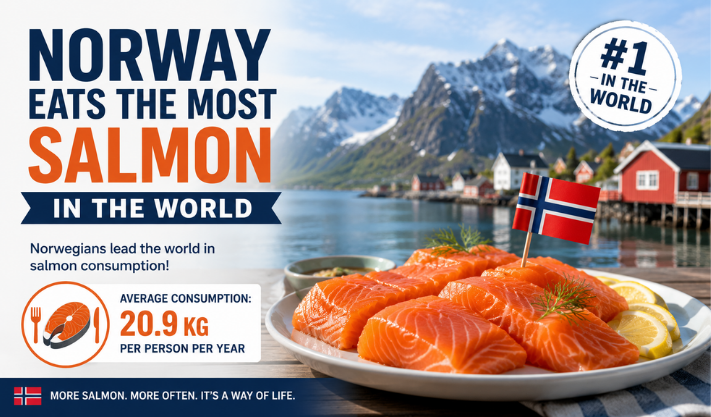
Norway Eats the Most Salmon in the World
Norway is known for its stunning fjords, icy waters, fishing traditions, and world-famous seafood. Among all the fish associated with the country, salmon is one of the most important.
The statement that Norway eats the most salmon in the world is widely shared online. However, the exact ranking can vary depending on how salmon consumption is measured. Despite this, Norway undoubtedly has a remarkably strong connection with salmon.
Norway is the world’s leading producer of farmed Atlantic salmon and one of the world’s largest salmon exporters. In 2025, Norway exported approximately 1.41 million tonnes of salmon, highlighting the enormous scale and importance of its salmon industry.
But why do Norwegians eat so much salmon, and is Norway really the country that consumes the most salmon in the world?
Why Do Norwegians Eat So Much Salmon?
Norway’s connection with salmon goes deep, both geographically and historically.
The country has a vast coastline, numerous islands, and thousands of fjords. Its cold marine waters provide favorable conditions for salmon farming and have helped Norway develop one of the world’s most successful aquaculture industries.
Fish has also been an important part of the Norwegian diet for centuries. Coastal communities traditionally depended on the sea for food and income, making seafood an important part of everyday Norwegian life.
Today, salmon is widely available in Norwegian supermarkets, restaurants, cafés, and homes. It can be prepared in many different ways, including grilled, baked, smoked, fried, or served raw in dishes such as sushi.
This combination of geography, tradition, and modern aquaculture has made salmon one of the foods most strongly associated with Norway.
Is Norway the World’s Biggest Salmon Producer?
Yes. Norway is widely recognized as the world’s leading producer of farmed Atlantic salmon.
Norway’s salmon farming industry expanded rapidly during the 1970s and has since developed into a sophisticated global business.
Modern Norwegian salmon farms use advanced systems for breeding, feeding, fish-health management, monitoring, and transportation. Salmon generally spend the early part of their life in freshwater before being transferred to marine farms.
Farmed Norwegian salmon typically takes around two to three years to reach harvest size.
Norway’s favorable coastal geography has played an important role in the growth of this industry. Sheltered fjords and cold seawater provide conditions that are well suited to Atlantic salmon farming.
How Much Salmon Does Norway Export?
Norway’s salmon industry is much larger than its domestic market.
In 2025, Norway exported approximately 1.41 million tonnes of salmon, making salmon one of the country’s most valuable seafood exports.
A large share of Norwegian salmon production is therefore destined for international markets rather than being consumed domestically.
Norwegian salmon is exported to countries across Europe, Asia, North America, and other parts of the world. The European market is particularly important for Norwegian seafood companies.
This huge export industry is one of the main reasons Norway has become synonymous with salmon around the world.
Does Norway Eat the Most Salmon in the World?
This question is more complicated than it first appears.
The claim “Norway eats the most salmon in the world” is commonly repeated online, but international rankings can produce different results depending on how consumption is calculated.
For example, researchers and organizations may measure:
- Total salmon consumption by country
- Salmon consumption per person
- Household consumption
- Retail sales
- Food supply
- Imported and exported salmon
- Seafood consumption overall
These different methods can produce different rankings.
A large country may consume more salmon in total because it has a larger population, while a smaller country may have higher per-capita salmon consumption.
For this reason, Norway’s exact position in a global salmon-consumption ranking should always be considered in the context of the source and methodology.
What is clear is that Norway is one of the world’s most important salmon-producing and salmon-consuming countries.
Salmon Is a Popular Food in Norway
Salmon is not simply an export product in Norway. It is also an important part of Norwegian food culture.
Norwegian salmon appears in both traditional and modern cuisine. Smoked salmon and other preserved fish preparations have long been associated with Nordic food traditions.
Fresh salmon is also extremely versatile.
It can be served with vegetables and potatoes, added to salads and pasta, used in sandwiches, or prepared as sushi and sashimi.
This versatility has helped salmon remain popular among different generations and eating habits.
Salmon can be found at restaurants, family meals, celebrations, and everyday dinners across Norway.
Why Is Norwegian Salmon So Popular Around the World?
Norwegian salmon has become one of the world’s most recognizable seafood products for several reasons.
Year-Round Availability
Large-scale aquaculture allows producers to supply salmon throughout the year rather than relying entirely on seasonal wild catches.
Established Seafood Industry
Norway has decades of experience in producing, processing, packaging, transporting, and exporting salmon.
Favorable Geography
Norway’s long coastline and numerous fjords provide suitable conditions for salmon farming.
Global Distribution
Norwegian salmon is exported to markets around the world, making it readily available to international consumers.
Versatility
Salmon can be prepared in many different ways, from traditional smoked salmon to sushi, poke bowls, salads, sandwiches, and grilled dishes.
Together, these factors have helped Norwegian salmon become a global food product.
Norway and the Rise of Salmon Sushi
One of the most interesting stories about Norwegian salmon is its connection with sushi.
Salmon was not traditionally one of the most common fish used in Japanese sushi. During the 1980s, however, Norwegian seafood interests helped introduce farmed Atlantic salmon to the Japanese market.
Over time, salmon became increasingly popular as a sushi ingredient.
Today, salmon is one of the most recognizable fish used in sushi around the world. It can be found in restaurants throughout Europe, North America, Asia, and many other regions.
The development of the salmon-sushi market helped transform Norwegian salmon from a traditional European seafood product into a truly global food.
Is Salmon Good for You?
Salmon is also popular because of its nutritional profile.
It is a good source of high-quality protein and provides omega-3 fatty acids. Salmon also contains nutrients such as vitamin D, vitamin B12, selenium, and iodine.
Because of these nutritional characteristics, salmon is frequently included in discussions about healthy eating.
However, the nutritional value of a meal depends on how the salmon is prepared and what it is served with.
For example, grilled or baked salmon served with vegetables is different from a heavily processed or high-calorie salmon dish.
As with any food, overall dietary balance and portion size are important.
Norway’s Salmon Industry Is a Global Business
Norway’s salmon industry is much more than a national food tradition. It is a major international business.
Norwegian salmon farms supply consumers around the world, while Norwegian companies have developed extensive networks for processing, packaging, transportation, and distribution.
International demand has made salmon one of Norway’s most valuable seafood exports.
However, the industry also faces challenges. These include fish health, environmental concerns, changing regulations, production conditions, and fluctuations in international demand.
Such factors can influence salmon production, prices, and availability in global markets.
Why Is Norway Known as the Salmon Country?
Norway’s close connection with salmon is the result of several factors working together.
Its long coastline provides favorable conditions for aquaculture. Its fishing history has created a strong seafood culture. Decades of investment have helped develop a sophisticated salmon-farming industry. International trade has then turned Norwegian salmon into a globally recognized product.
Today, Norwegian salmon is consumed in countries all over the world.
This gives Norway a unique position. The country is not only an important consumer of salmon but also one of the world’s dominant producers and exporters.
What Makes Norway’s Salmon Industry Different?
Norway has built an entire ecosystem around salmon production.
The industry includes fish farmers, feed producers, processing companies, transportation providers, exporters, restaurants, retailers, and other businesses.
This integrated supply chain allows salmon to move efficiently from Norwegian farms to consumers in international markets.
The scale of the industry also means that developments in Norway can influence the global salmon market.
Changes in production, environmental conditions, regulations, or international demand can have effects far beyond Norway itself.
Is Norway Really the Biggest Salmon Eater?
The answer depends on what “biggest salmon eater” means.
If the question refers to total consumption, population size can significantly influence the ranking. If it refers to consumption per person, smaller countries can potentially rank higher.
Online rankings can also combine statistics from different sources, making direct comparisons difficult.
Therefore, it is better to avoid treating the statement that Norway is definitively the world’s number-one salmon consumer as an unquestionable fact.
What can be said confidently is that Norway has one of the world’s strongest relationships with salmon, both culturally and commercially.
Conclusion
The claim that Norway eats the most salmon in the world is a popular description of the country’s strong relationship with salmon. However, the exact number-one position depends on how salmon consumption is defined and which datasets are being compared.
What is clear is Norway’s enormous importance to the global salmon industry. Norway is the world’s leading producer of farmed Atlantic salmon and exported approximately 1.41 million tonnes of salmon in 2025.
Salmon is also deeply connected to Norwegian food culture. It appears in traditional dishes, modern meals, restaurants, family dinners, and international cuisine.
From smoked salmon to sushi, sashimi, grilled fillets, salads, and poke bowls, Norwegian salmon has traveled far beyond the country’s fjords.
So, while the precise claim that Norway consumes more salmon than every other country should be interpreted carefully, Norway’s position as a global salmon powerhouse is undeniable.
Its combination of natural geography, seafood traditions, advanced aquaculture, and international trade has made Norway and salmon almost synonymous around the world.
Also Read:-
What Makes Germany a Strong Technology and AI Market?
What Are the Top 10 Skincare Tips for Clear Skin?
Where Are the Best Places to Buy Real Estate in Switzerland?