
Markets Once Expected to Lose from Iran War Are Now Leading in 2026
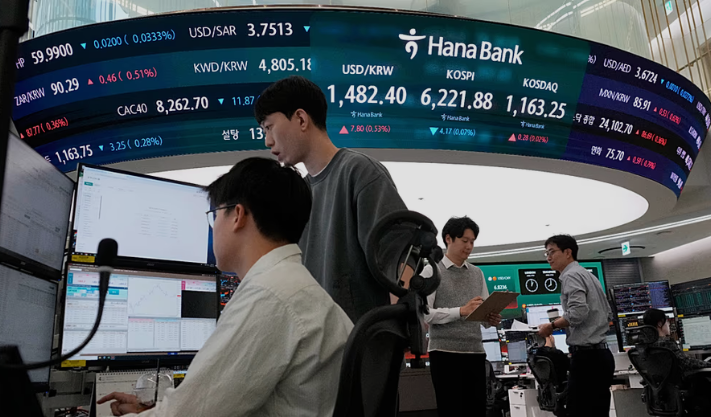
The stock markets that many thought would suffer the most from the Iran war are now performing the best in 2026. After the panic in March over the Strait of Hormuz, markets have bounced back strongly. This recovery has become one of the fastest and most powerful rallies in recent years.
The story of financial markets in 2026 can be divided into three main phases, each more dramatic than the last.
The first phase lasted from January to late February. During this time, global stock markets were rising. Investors expected central banks to cut interest rates, which helped boost confidence. At the same time, a strong demand cycle for memory chips pushed markets in South Korea and Taiwan to record highs.
The second phase began on February 28, when joint airstrikes by the United States and Israel triggered what is now called the Iran war. This event created fear and uncertainty across global markets.
The third phase, which is still ongoing, started in early April. A ceasefire proposal, helped by Pakistan, gave markets hope and helped them recover from earlier losses.
Between these phases, markets went through major damage. One of the biggest shocks came when the Strait of Hormuz was closed on March 4. This caused oil prices to rise sharply, with Brent crude crossing $120 per barrel.
South Korea’s main stock index, the KOSPI, was hit hard. After gaining more than 50% in the first two months of the year, it fell by 19% in March. This was its biggest monthly drop since the 2008 financial crisis.
In the United States, the S&P 500 nearly entered correction territory, meaning it came close to a significant decline. European markets also dropped as economists warned about the risk of stagflation, which is a combination of slow growth and high inflation.
Then, things started to change.
On March 31, Pakistan and China introduced a five-point peace plan, calling for an immediate stop to the fighting. The next day, Donald Trump said that Iran had asked for a ceasefire, but only if the Strait of Hormuz was reopened. On April 7, he officially announced a two-week ceasefire agreement with Iran.
Since then, oil prices have fallen by nearly 25%. This drop has helped global stock markets recover quickly, creating a strong relief rally.
Looking at stock market performance in 2026 so far, South Korea stands out as the top performer. Its KOSPI index has gained over 51% this year, far ahead of other major markets. For comparison, the S&P 500 has risen only about 3.8%, the Nasdaq around 5%, and Europe’s Euro Stoxx 50 about 3.4%.
South Korea’s strong performance is mainly driven by two companies: Samsung Electronics and SK Hynix. Together, they make up about 41% of the KOSPI index. Both companies have seen their stock prices rise by nearly 80% this year.
The main reason behind this growth is the booming demand for memory chips, especially those used in artificial intelligence (AI). Samsung reported record profits in the first quarter of 2026, with a large increase driven by higher prices for AI-related memory products. SK Hynix has also secured long-term deals with major cloud and graphics processing companies, which experts believe will keep demand strong.
However, this heavy dependence on a few companies has both advantages and risks. It explains why South Korea’s market rose so quickly before the war, fell sharply during the crisis, and then recovered so strongly afterward.
Some analysts had predicted this recovery. In early March, during the market decline, analysts from Goldman Sachs described the drop as temporary and said it would likely be followed by a return to new highs. This prediction has turned out to be accurate.
When looking at country exchange-traded funds (ETFs), the picture changes slightly. If we measure performance from the start of the war in late February, South Korea’s ETF has remained flat. This means that while the market recovered, it only made up for earlier losses.
The best-performing ETFs during the war period fall into three groups. First are oil-producing countries like Saudi Arabia, Norway, Brazil, and Colombia, which benefited from higher oil prices. Second are technology-focused markets like Taiwan, which remained stable during the crisis. Third are emerging markets such as Argentina, Turkey, and Poland, which tend to show higher volatility and stronger movements.
If we measure performance from the market low point before the ceasefire in late March, the recovery looks even more impressive. From that point, South Korea and Taiwan are again the top performers. These countries depend heavily on oil imports from the Middle East, so they were hit hard when oil prices surged. When oil prices dropped after the ceasefire, their markets rebounded strongly.
Greece is another interesting case. Although it does not have a strong semiconductor industry like South Korea, its stock market performed well after the ceasefire. This was helped by falling oil prices and the possibility that the European Central Bank might avoid raising interest rates.
Other European markets, including Poland, the Netherlands, Sweden, and Austria, showed similar patterns. Their recovery reflects the easing of energy costs and reduced economic pressure.
Overall, the market data in 2026 tells three key stories. First, it shows which markets were strong at the beginning of the year. Second, it highlights which markets were less affected by the war. Third, it reveals which markets had the most to recover after the crisis.
South Korea is the only market that appears at the top in two of these categories. This makes it one of the most important market stories of 2026 so far.
However, there is still uncertainty ahead. The two-week ceasefire announced by Donald Trump is about to end. Talks are ongoing in Islamabad to decide whether the ceasefire will be extended or if the conflict will resume.
As of now, the Strait of Hormuz has not fully reopened, and both sides have accused each other of breaking the agreement. This creates risk for global markets.
South Korea’s market has performed extremely well this year, but the next two weeks will be critical. They will determine whether the recent rally continues or if it was just a temporary peak.
In short, markets that were expected to lose the most from the Iran war have surprised everyone by becoming the top performers. But with the situation still uncertain, the story of 2026 is far from over.
Also Read:-
How Leading Brands Are Approaching ChatGPT Advertising
EU Population to Drop 12% by 2100: Hardest-Hit Nations
Travel + Leisure Reveals Top New Luxury Hotels Globally Now