
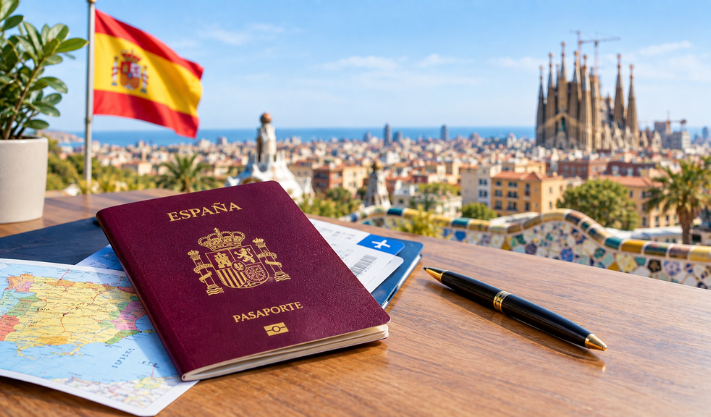
Step by Step Guide: How to Apply for a Passport in Spain?
A Spanish passport is an important travel document for Spanish citizens who want to travel abroad. It confirms the holder’s identity and Spanish nationality and allows them to travel internationally.
If you want to know how to apply for a passport in Spain, the process is generally straightforward. You need to make an appointment, prepare the required documents, attend the appointment in person, provide a suitable photograph when required, pay the passport fee, and complete the application at the appropriate documentation office.
However, there is an important difference between applying for a Spanish passport and becoming eligible for one. Spanish passports are issued to Spanish citizens. Foreign nationals who do not have Spanish nationality generally need to acquire Spanish nationality before they can apply for a Spanish passport.
This step-by-step guide to applying for a passport in Spain explains the eligibility requirements, required documents, appointment process, passport fees, renewal, children’s passports, passports for Spanish citizens living abroad, and frequently asked questions.
Who Can Apply for a Spanish Passport?
A Spanish passport can be issued to people who have Spanish nationality.
Spanish citizens living in Spain can generally apply for or renew their passport through the appropriate Police documentation office. Applicants normally need to appear in person and provide the required identification and supporting documents.
Spanish citizens living abroad can generally apply through a Spanish embassy or consulate. The exact documentation requirements may vary depending on the applicant’s circumstances and whether their Spanish nationality needs to be verified.
If you are a foreign resident in Spain, simply having a residence permit does not automatically make you eligible for a Spanish passport. You generally need to obtain Spanish nationality first.
What Are the Requirements for a Spanish Passport?
Before beginning your Spanish passport application, make sure you have the documents required for your individual circumstances.
For an ordinary passport application in Spain, applicants generally need to:
- Have a valid Spanish DNI.
- Provide a recent colour passport photograph that meets the official requirements, when required.
- Present an existing valid passport if applicable, so it can be cancelled.
- Provide any additional documents required for their particular circumstances.
- Attend the application appointment in person.
A separate photograph may not be necessary if the applicant has obtained or renewed their DNI on the same day.
Children and applicants with special circumstances may have additional documentation requirements.
Step-by-Step Guide to Applying for a Passport in Spain
Step 1: Confirm Your Spanish Nationality
The first step is to confirm that you are eligible for a Spanish passport.
If you are already a Spanish citizen, you can proceed with your passport application.
If you are a foreign citizen living in Spain, you generally cannot apply directly for a Spanish passport simply because you live in the country or have a residence permit. You must first acquire Spanish nationality through an applicable legal process.
Spain has several routes for acquiring nationality, including nationality by residence, option, discretionary grant, and possession of status. Once Spanish nationality has been legally acquired and registered, the person can proceed with the relevant Spanish identification and passport procedures.
Therefore, before starting your Spanish passport application, make sure you have the nationality status required to apply.
Step 2: Make a Passport Appointment
Once you are eligible for a Spanish passport, the next step is to arrange an appointment.
Applicants in Spain generally need to attend an appropriate documentation unit to complete the passport procedure. An appointment can be requested through the relevant official appointment system or by telephone.
Appointment availability can vary depending on the location. If you have an upcoming international trip, it is sensible to arrange your appointment well in advance.
When making the appointment, carefully select the appropriate service for your DNI and/or passport.
Before confirming the appointment, check:
- The date and time.
- The documentation office location.
- The type of appointment.
- The documents you need to bring.
- The accepted payment methods.
Step 3: Check Your DNI
For most passport applications made in Spain, you need to provide a valid Spanish DNI.
Your DNI should be valid and in good condition. Before attending your appointment, check that the information on your identification document is correct.
Make sure:
- Your DNI has not expired.
- Your personal information is accurate.
- The document is not damaged.
- You have the original DNI with you.
If your DNI has expired or needs to be renewed because of damage or changes in your personal information, you may need to complete the relevant DNI procedure before or alongside your passport application.
Having your identification documents ready can help prevent unnecessary delays.
Step 4: Prepare Your Passport Photograph
A recent colour photograph may be required when applying for a Spanish passport.
The photograph should meet the official passport-photo requirements. The standard photograph size is 32 × 26 millimetres, with a uniform white background.
The applicant should face the camera directly, and their face must be clearly visible. Sunglasses and other items that prevent or hinder identification should not be worn unless permitted under the applicable requirements.
Avoid using casual photographs or photographs that do not meet the official specifications.
If you have obtained or renewed your DNI on the same day, a separate passport photograph may not be required in certain circumstances.
Step 5: Bring Your Existing Passport If You Have One
If you already have a Spanish passport and are applying for a renewal or replacement, bring your current passport to the appointment.
When a valid passport is being replaced, the existing passport may need to be presented so that it can be cancelled as part of the process.
This is particularly important if you are renewing your passport before an upcoming international trip.
If your previous passport has been lost or stolen, do not simply arrive at the appointment without explaining what happened. Follow the relevant procedure for a lost or stolen passport and provide any required documentation.
Step 6: Attend the Appointment in Person
Physical presence is an important part of the passport application process in Spain.
Applicants generally need to attend the documentation office personally. This allows officials to verify the applicant’s identity and complete the passport procedure.
Take all required documents with you.
Spanish Passport Appointment Checklist
Before leaving for your appointment, check that you have:
- Valid Spanish DNI.
- Recent passport photograph, if required.
- Existing Spanish passport, if applicable.
- Required supporting documents.
- Appropriate payment method.
- Additional documents for minors or special circumstances.
Arriving prepared can make the application process easier and reduce the risk of having to make another appointment.
Step 7: Pay the Spanish Passport Fee
Applicants must pay the applicable passport fee when completing the procedure.
The ordinary Spanish passport fee is currently €30 for issuance or renewal. Certain applicants who qualify as members of a recognised large family may be exempt from the fee under the applicable rules.
Depending on the available procedure, payment can be made using accepted payment methods at the documentation unit or through the permitted online payment process.
Government fees and payment arrangements can change, so it is important to check the latest official information before attending your appointment.
Step 8: Complete the Passport Application
At the documentation office, officials will check your identity and supporting documents before completing the passport application.
Pay attention to your personal information during the process.
Check details such as:
- Full name.
- Date of birth.
- Nationality.
- Identification information.
- Other personal details.
If you notice an error or believe information is incorrect, ask the official handling your application for clarification before the procedure is completed.
Providing accurate information is important because the details on your passport are used for international identification and travel.
Step 9: Follow Additional Requirements for Children
The Spanish passport application process for children can involve additional documentation.
If a minor does not have a DNI because they are not legally required to have one, additional civil-registration documentation may be required.
Depending on the child’s circumstances, parents or legal representatives may need to provide documents such as:
- Birth documentation.
- Family documentation.
- Proof of legal guardianship.
- Judicial or administrative documentation where applicable.
- Identification documents of parents or legal representatives where required.
Parents should check the requirements that apply to their child’s specific situation before attending the appointment.
It is particularly important to check the requirements if only one parent or legal representative is involved or if there are special guardianship circumstances.
Step 10: Receive Your Spanish Passport
Once the application has been completed and the necessary checks have been carried out, your Spanish passport can be issued according to the applicable procedure.
When you receive your passport, carefully check the information before leaving.
Look at:
- Your full name.
- Date of birth.
- Nationality.
- Passport number.
- Expiry date.
- Other personal information.
If you notice an error, report it to the relevant authority as soon as possible.
How Long Is a Spanish Passport Valid?
The validity period of a Spanish passport generally depends on the age of the holder.
According to Spanish government information:
- Children under 5 years old generally receive a passport valid for 2 years.
- People under 30 generally receive a passport valid for 5 years.
- People aged 30 or older generally receive a passport valid for 10 years.
Certain rules can apply to minors and people under guardianship, so the exact validity period should be checked for the individual applicant.
Always check the expiry date of your passport before planning international travel.
Can You Renew a Spanish Passport Before It Expires?
Yes, a Spanish passport can be renewed before its expiry in accordance with the applicable rules.
Spanish government information states that a new passport can generally be requested when the existing passport has 12 months or less of validity remaining.
Renewing your passport before an important trip can help you avoid travel problems associated with an expired or nearly expired passport.
However, passport validity requirements can vary between countries. Some destinations require your passport to remain valid for a specific period after your arrival.
Therefore, check the passport and visa requirements of your destination before travelling.
How Can Spanish Citizens Living Abroad Apply for a Passport?
Spanish citizens who live outside Spain can generally apply for a Spanish passport through the relevant Spanish embassy or consulate.
The documentation requirements may differ from those for people applying in Spain.
Depending on the circumstances, Spanish citizens abroad may be able to use certain civil-registration documentation or an existing passport to establish their identity and nationality.
If there is uncertainty about Spanish nationality, additional documentation, such as a recent literal birth certificate, may be requested.
Spanish citizens living abroad should contact the appropriate Spanish diplomatic or consular representation before applying to confirm the current requirements.
What If Your Spanish Passport Is Lost or Stolen?
If your Spanish passport is lost or stolen, report the situation to the appropriate authorities and follow the procedure for obtaining replacement documentation.
If you lose your passport while travelling outside Spain, contact the nearest Spanish embassy or consulate for assistance.
It is also useful to keep copies of important travel documents separately from the original documents. This can make it easier to establish your identity if your passport is lost or stolen.
Do not continue travelling as though nothing happened after losing your passport. Contact the relevant authorities as soon as possible.
What If Your Spanish Passport Is Damaged?
A badly damaged passport can cause problems during international travel, particularly if important personal information or security features are affected.
If your passport is significantly damaged, consider obtaining a replacement before travelling.
Airlines and foreign border authorities may have their own requirements for accepting travel documents, so do not assume that a damaged passport will always be accepted.
If you are unsure whether your passport needs to be replaced, contact the appropriate Spanish passport authority for guidance.
Can Foreigners Get a Spanish Passport?
Foreign nationals cannot normally obtain a Spanish passport simply because they live in Spain.
The key requirement is Spanish nationality.
A foreign resident may first need to acquire Spanish nationality through an eligible legal process. Spain provides different routes for acquiring nationality, including nationality by residence, option, discretionary grant, and possession of status.
Once Spanish nationality has been acquired and registered, the person can proceed with the relevant Spanish identification and passport procedures.
This means that Spanish residency and Spanish nationality are not the same thing.
Having a Spanish residence permit does not automatically give a person the right to obtain a Spanish passport.
Common Mistakes When Applying for a Spanish Passport
A passport application can become more complicated if you arrive without the correct documents or fail to check the application requirements.
Here are some common mistakes to avoid.
1. Taking an Expired DNI
Check your DNI before your appointment. If it has expired, determine whether it needs to be renewed before completing your passport application.
2. Using an Incorrect Passport Photograph
Your photograph must meet the official requirements for size, background and identification.
3. Forgetting Your Existing Passport
If you are renewing a valid Spanish passport, remember to bring the existing document when required.
4. Not Checking Your Appointment Details
Check the appointment date, time, location and service before travelling to the documentation office.
5. Waiting Until the Last Minute
If you have an international trip planned, do not wait until just before departure to apply or renew your passport.
6. Ignoring Destination-Country Requirements
Having a valid Spanish passport does not automatically mean you can enter every country without additional requirements.
Depending on your destination, you may need a visa or may need your passport to remain valid for a particular period.
Always check the entry requirements before travelling.
Spanish Passport Application Checklist
Use this checklist before attending your appointment:
- Confirm that you have Spanish nationality.
- Arrange the required passport appointment.
- Check that your DNI is valid.
- Prepare a compliant passport photograph if required.
- Bring your existing passport if applicable.
- Prepare additional documentation for children or special circumstances.
- Prepare the applicable passport fee.
- Attend the appointment personally.
- Check all information on your new passport.
- Check the passport expiry date before travelling.
FAQs
How Much Does a Spanish Passport Cost?
The ordinary Spanish passport fee is currently €30 for issuance or renewal. Some applicants who qualify as members of a large family may be exempt from the fee under the applicable rules.
Can I Apply for a Spanish Passport Online?
The passport application itself generally requires the applicant to appear in person at the relevant documentation unit. However, an appointment and certain payment steps can be arranged through the permitted official systems.
Do I Need a DNI to Apply for a Spanish Passport?
For applicants applying in Spain, a valid Spanish DNI is generally required. Different documentation rules can apply to Spanish citizens living abroad or applicants in special circumstances.
Do I Need a Passport Photo?
A recent colour photograph meeting the official requirements is generally required. However, a separate photograph may not be necessary in certain situations when the applicant has obtained or renewed their DNI on the same day.
Can a Foreign Resident in Spain Get a Spanish Passport?
Not simply because they have Spanish residency. A person generally needs to have Spanish nationality before they can obtain a Spanish passport.
How Long Is a Spanish Passport Valid?
Generally, Spanish passports are valid for two years for children under five, five years for people under 30, and ten years for people aged 30 or older, subject to applicable rules.
Can I Renew My Spanish Passport Before It Expires?
Yes. Under the applicable rules, a new passport can generally be requested when the existing passport has 12 months or less of validity remaining.
Can a Child Get a Spanish Passport?
Yes. Spanish children can obtain passports, but additional documentation and parental or legal-guardian requirements may apply.
What Should I Do If My Spanish Passport Is Lost Abroad?
Contact the nearest Spanish embassy or consulate and report the loss or theft to the appropriate authorities. The consular office can explain the documentation and travel options available for your circumstances.
Final Answer
Applying for a Spanish passport is a structured process when you have the correct documents and meet the eligibility requirements.
First, confirm that you have Spanish nationality. Next, arrange the required appointment, check your DNI, prepare a suitable photograph and supporting documents, attend the appointment in person, pay the applicable fee, and complete the passport application.
For a standard passport application in Spain, applicants generally need a valid DNI and a compliant recent photograph when required. An existing passport should also be presented when applicable. The ordinary Spanish passport fee is currently €30, while qualifying large-family applicants may be exempt.
If you are a foreign resident in Spain, remember that having a residence permit is different from having Spanish nationality. You generally need to acquire Spanish nationality first before you can apply for a Spanish passport.
Preparing your documents carefully, checking the appointment requirements, and confirming the latest official rules before applying can help make the Spanish passport application process easier and reduce unnecessary delays.
Also Read:-
Step by Step Guide: How to Apply for a Passport in the Italy?
Step by Step Guide: How to Apply for a Passport in Germany?
How to Get a Passport in France: Step-by-Step Guide