
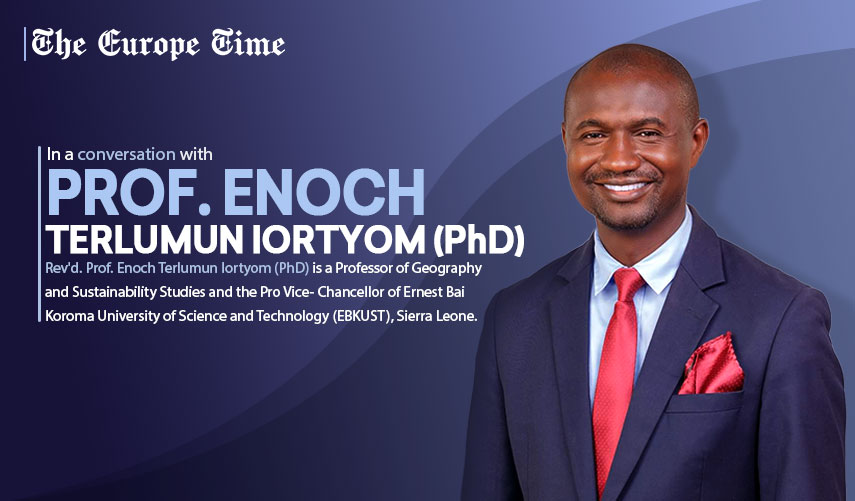
Pro Vice-Chancellor highlights Magburaka Campus’s technology and innovation focus, research, partnerships and the role of African universities in development
Rev’d. Prof. Enoch Terlumun Iortyom, PhD, is a Professor of Geography and Sustainability Studies whose scholarship connects geographical inquiry with practical challenges in food systems, geographic information system and remote sensing, environmental sustainability and development. He describes Geography as more than an academic discipline: it offers a practical way to understand real-life challenges and develop solutions that improve people’s lives.
Speaking in an interview with The Europe Time, Professor Iortyom said his interest in Geography grew from a curiosity about people, the environment and the forces that shape everyday life. He holds a PhD in Geography from the University of Fort Hare, South Africa, and an MSc and BSc (Hons) in Geography from Benue State University, Nigeria. He specializes in geographies of food and agriculture. His research interests include the food security and sustainable development, natural resources development and management, geographic information system and remote sensing, climate change, environmental economics, governance and security.
At Ernest Bai Koroma University of Science and Technology (EBKUST), Sierra Leone, Professor Iortyom serves as Pro Vice-Chancellor, as well as Deputy Vice-Chancellor of Magburaka Campus. He said he was excited by the opportunity to contribute to the growth of a young university with considerable potential.
He credited the university’s Vice-Chancellor and Principal, Rev’d. Prof. Edwin Julius Jeblar Momoh (PhD), for giving him the opportunity to be part of that growth. He said EBKUST could make a meaningful contribution to education, research and community development in Sierra Leone by strengthening academic standards, creating opportunities and fostering a culture of innovation and excellence.
Reflecting on the university’s institutional heritage, Professor Iortyom said the institutions that came together to form EBKUST brought valuable experience in religious education, teacher education, technical training, agricultural research and community service. He said the university should preserve the strengths of that history while embracing new ideas and responding to contemporary needs.
As Acting Dean of the Faculty of Geography, Environment, Tourism and Sustainability Studies, he sees significant opportunities for students in fields increasingly important to society. These include climate change, geographic information system and remote sensing, environmental management, sustainable tourism, urban planning, natural-resource conservation and development studies.
According to Professor Iortyom, graduates in these areas can contribute across government, the private sector, development organizations and research. Their role, he said, should extend beyond securing employment to applying their knowledge to solve practical problems and improve people’s lives.
Research and innovation, he added, are essential to the university’s contribution to national development. He acknowledged the efforts of Professor Momoh to strengthen these areas and recalled his own service as Pioneer Dean of the School of Postgraduate Studies, where he helped support postgraduate research and the development of a stronger research culture.
He said the university wants staff and students not only to acquire knowledge but also to produce research that addresses real challenges and makes a practical difference in society.
On international cooperation, Professor Iortyom said universities could not afford to work in isolation. Partnerships enable institutions to learn from one another, share knowledge, undertake joint research and create opportunities for staff and students.
He expressed gratitude to Professor Momoh for entrusting him with the responsibility as University Coordinator for International Partnerships and Collaborations. He said he viewed the role as an opportunity to build relationships that benefit EBKUST, strengthen its academic programs and expose staff and students to wider opportunities.
Turning to his vision for Magburaka Campus, where he serves as Deputy Vice-Chancellor, Professor Iortyom said his priorities include improved infrastructure, higher academic quality and making the campus a model of purposeful transformation within EBKUST.
He emphasized that Magburaka Campus houses the university’s technology and innovation focus. Its academic structure comprises the following faculties and programs:
Faculty of Engineering and Technology
- BSc Computer Science
- BSc Business Information Technology
- BEng Network and Telecommunication Engineering
- BEng Mining Engineering
- BEng Electrical and Electronics Engineering
- BEng Civil and Environmental Engineering
- BTech Information Systems Management
- BTech Renewable Energy
- BEng Automotive Engineering
- BSc Geology
- BEng Mechanical and Manufacturing Engineering
- BSc Fashion Design and Textile Technology
Faculty of Geography, Environment, Tourism and Sustainability Studies
- BSc Geography and Environmental Management
- BSc Development Studies
- BSc Eco-Tourism and Environmental Conservation
Faculty of Religious and Interfaith Studies
- BA Islamic Religious Studies
- BA Christian Religious Studies
- BA Philosophy and Interfaith Studies
- BSc Guidance and Counselling
Directorate of the Institute of Technical, Vocational Education and Training (ITVET)
The Directorate provides short, competency-based certificate training in practical trades and professional skills. Its programmes include:
Engineering and Technical Trades
- Refrigeration and air conditioning
- Electrical installation and maintenance
- Welding and fabrication
Mining
- Gold assaying and valuation
- Drilling and sampling techniques
- Health, safety and risk management
- Geological mapping
- Sustainable minerals management
Construction and Building Technology
- Bricklaying and masonry
- Carpentry and joinery
- Painting and decoration
- Tiling and flooring
- Plumbing and pipe fitting
Automotive and Transport
- Auto mechanics
- Auto electrical systems
- Vehicle body repair and spray painting
- Heavy-duty equipment maintenance
- Motorcycle mechanics
- General fitting
Energy and Utilities
- Solar PV installation and maintenance
- Electrical power systems
- CCTV technology
ICT and Digital Skills
- Graphic design and branding
- Data entry and office applications
- Networking and system administration
- Computer hardware and maintenance
- AI for teaching and learning
Geographic Information Systems
- Land surveying
- Cartography and map production
- Geophysical survey
- Spatial data collection
- GIS software operations
- Web GIS and mapping
Fashion and Beauty
- Tailoring and garment making
- Shoe craft and leatherwork
- Fashion design
- Hairdressing
- Cosmetology and beauty therapy
- Embroidery and machine operations
- Tie-and-dye processing
- Makeup artistry
Professor Iortyom said he wants Magburaka Campus to provide an environment where staff can work effectively, students can learn in a supportive setting and the surrounding community can see the positive impact of the university. He also acknowledged Professor Momoh for creating an enabling environment for the campus to pursue that vision.
For EBKUST as a whole, his aspiration is for the institution to be recognized for academic excellence, meaningful research, innovation and service to communities.
Looking more broadly at higher education in Africa, Professor Iortyom said universities must prepare young people not only to earn degrees but also to think critically, solve problems, create opportunities and contribute to the development of their societies. He described this as one of the most important responsibilities of higher education.
Connect with Prof.Enoch Terlumun Iortyom(PhD) on Facebook
Also Read:-
Lohran Queiroz: Football to Latin American Tech Leadership
Step by Step Guide: How to Apply for a Passport in Latvia?
Step by Step Guide: How to Apply for a Passport in Estonia?