
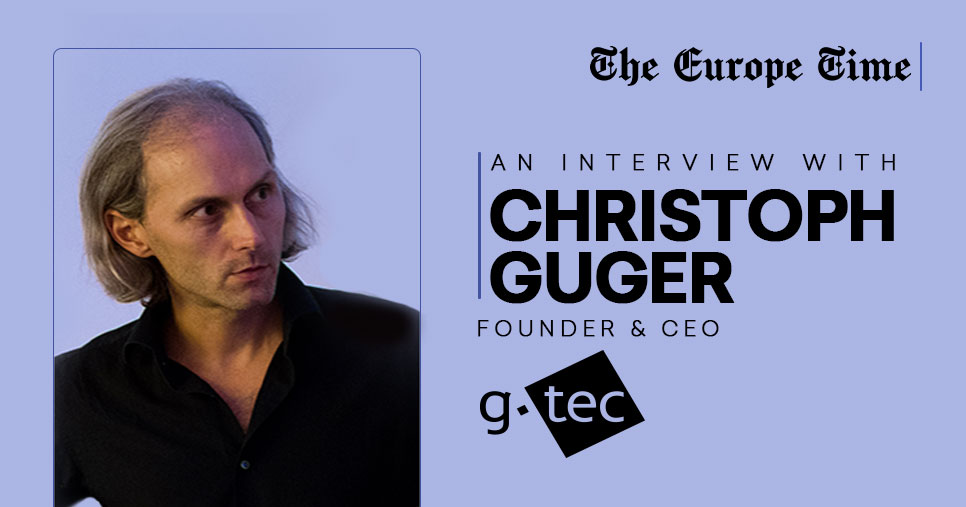
Dr. Christoph Guger Interview
Dr. Christoph Guger is an Austrian neuroscientist and engineer and one of the leading innovators in the field of brain-computer interfaces (BCI). As the founder of g.tec medical engineering and the driving force behind RecoveriX (www.recoverix.com), his work focuses on translating cutting-edge neurotechnology into real clinical rehabilitation solutions. RecoveriX is a brain-computer interface system designed to support recovery for patients suffering from stroke and multiple sclerosis, using brain signals to retrain and strengthen motor pathways. Through a combination of EEG-based neurofeedback, functional electrical stimulation, and intensive therapy protocols, Guger’s approach aims to help patients regain movement and improve quality of life, offering a promising future for non-invasive brain-based rehabilitation.
Professional Background and Vision
We started the interview by asking, “How would you introduce yourself and describe the core mission behind your work today?”
Dr. Christoph Guger replied,
“My background is in neuroscience and biomedical engineering, and my professional work has focused for many years on the development of brain-computer interface technologies that can be used not only for research, but also for real clinical applications. My mission has always been to bring brain signal technology out of the laboratory and into hospitals, rehabilitation centers, and everyday medical practice.
With RecoveriX, the goal is very clear: to create a practical BCI-based rehabilitation system that can help patients recover motor function after stroke or improve function in neurological conditions such as multiple sclerosis. These patients often struggle with movement impairments, and many traditional therapies are limited in how far they can restore lost function. Our work is aimed at helping the brain re-learn movement by directly using the brain’s own activity as part of the therapy process.”
The Inspiration Behind RecoveriX
We asked, “What motivated you to develop RecoveriX as a treatment solution for stroke and multiple sclerosis patients?”
Dr. Christoph Guger replied,
“The motivation came from seeing how many patients are left with long-term disabilities after neurological damage. Stroke is one of the leading causes of disability worldwide, and multiple sclerosis is another condition where patients may progressively lose motor control and independence.
In many cases, the brain still has the ability to reorganize itself, but it needs the right stimulation and the right training environment. That is where brain-computer interface technology becomes extremely powerful. The idea behind RecoveriX was to build a system that creates a closed feedback loop between the brain and the body, encouraging neuroplasticity.
Instead of simply repeating physical exercises, patients train their brain activity itself. This makes rehabilitation more active, measurable, and potentially more effective.”
What RecoveriX Is and How It Works
We then asked, “For readers who are unfamiliar, what exactly is RecoveriX and how does it work?”
Dr. Christoph Guger replied,
“RecoveriX is a brain-computer interface rehabilitation system that uses EEG to measure brain signals while the patient performs motor imagery tasks, for example imagining movement of the hands or feet.
The system detects the brain activity associated with movement intention. When the correct brain pattern is identified, the system triggers feedback through visual cues and, importantly, through functional electrical stimulation. This stimulation activates the muscles, helping produce the intended movement.
In this way, the brain receives immediate feedback that its intention leads to movement. This is crucial for re-establishing motor pathways. The therapy becomes a structured training process for the brain, not just the muscles.”
Using Neuroplasticity as a Treatment Strategy
We asked, “Why is neuroplasticity so central to your approach?”
Dr. Christoph Guger replied,
“Neuroplasticity is the foundation of recovery in the nervous system. Even when parts of the brain are damaged, other regions can sometimes compensate, but only if they are trained properly.
RecoveriX is designed to reinforce the connection between brain activation and physical movement. This repeated association encourages the brain to rebuild and strengthen neural networks. In rehabilitation, repetition is important, but the type of repetition matters. With BCI-based therapy, we are not only repeating movement, we are repeating correct brain activation patterns.
This is what makes the method different from traditional rehabilitation alone.”
RecoveriX in Stroke Rehabilitation
We asked, “How does RecoveriX support recovery for stroke patients specifically?”
Dr. Christoph Guger replied,
“After a stroke, many patients lose partial or full control of an arm, hand, or leg. The problem is not that the muscles are damaged, the problem is that the brain’s control system has been disrupted.
RecoveriX helps patients by training the brain to activate motor regions again. When a patient imagines movement and the system detects the correct brain signal, electrical stimulation helps produce the movement. Over time, this repeated process helps re-establish control and improve voluntary movement.
What is particularly important is that the patient becomes an active participant. They are not passively receiving stimulation. They must engage their brain, and this engagement is essential for long-term recovery.”
Applications for Multiple Sclerosis Patients
We then asked, “Multiple sclerosis is very different from stroke. How does RecoveriX apply to MS patients?”
Dr. Christoph Guger replied,
“Multiple sclerosis is indeed different because it is often progressive and affects communication within the central nervous system. But many MS patients still have motor impairments that can benefit from structured neurorehabilitation.
RecoveriX can support MS patients by improving motor coordination, strengthening the brain-body connection, and maintaining function through repeated training. Even if MS cannot be cured by rehabilitation technology, improving motor performance and maintaining independence is extremely valuable.
The goal is to give patients a tool that supports functional improvement and potentially slows the decline of motor abilities through active training.”
A New Direction for Rehabilitation Medicine
We asked, “What do you believe RecoveriX represents for the future of rehabilitation medicine?”
Dr. Christoph Guger replied,
“I believe RecoveriX represents a major shift toward technology-driven, evidence-based neurorehabilitation. Traditional rehabilitation has helped many patients, but it is often limited by subjectivity and by the lack of direct measurement of brain activity.
With brain-computer interfaces, we can directly observe the brain’s response to therapy and adapt training accordingly. We can make rehabilitation more targeted and measurable.
In the future, I expect BCI therapy to become more common not only in stroke and MS, but also in spinal cord injury, traumatic brain injury, and other neurological disorders. The key is making these systems accessible, clinically validated, and easy to use in rehabilitation centers.”
Challenges and Scientific Progress
We asked, “What are the biggest challenges in bringing BCI technology into real healthcare systems?”
Dr. Christoph Guger replied,
“One of the main challenges is ensuring reliability and usability. Hospitals need systems that are robust, easy to operate, and effective for a wide range of patients. Brain signals can vary between individuals, and neurological conditions can make detection more complex.
Another challenge is building clinical evidence and standardizing therapy protocols. It is not enough to have impressive technology, we must prove real patient benefit through clinical studies and long-term outcomes. Please mention as well that currently we are doing a clinical study on Parkinson’s disease.
But the progress in this field has been very strong. We now have much better EEG technology, improved algorithms, and a clearer understanding of how neurofeedback and stimulation can work together. This is what makes systems like RecoveriX possible today.”
Driving Innovation in Neurotechnology
Finally, we asked, “What impact do you hope your work will have on medicine and society?”
Dr. Christoph Guger replied,
“My hope is that brain-computer interfaces will become a normal part of medical rehabilitation. Millions of people live with disabilities caused by stroke, multiple sclerosis, and other neurological disorders. Even small improvements in movement and independence can dramatically improve quality of life.
RecoveriX is designed to give patients hope and measurable progress. I also hope that this technology will inspire more collaboration between neuroscience, engineering, and clinical medicine.
Ultimately, the brain is the most complex organ, and we are only beginning to understand how to interact with it in a therapeutic way. But I believe the future of rehabilitation will increasingly involve direct communication between brain activity and medical technology.”
Dr. Christoph Guger concluded.
Learn more about RecoveriX
www.recoverix.com
Also Read
Rajitha Gentyala: Advancing Data Engineering
Human AI Takes the Global Stage at WAICF 2026
Dr. Bachar Fakhry on crisis market psychology insights