
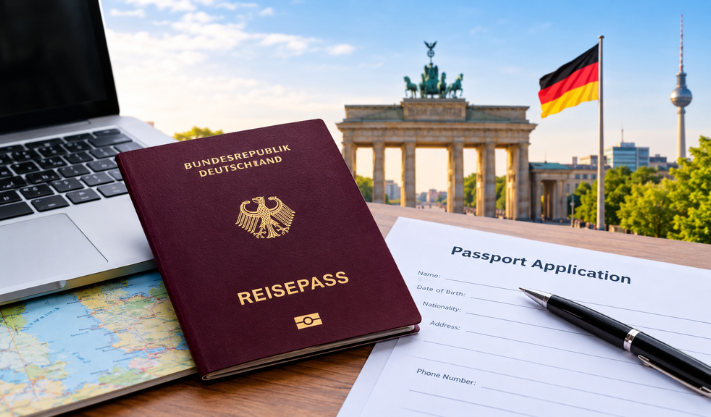
Step by Step Guide: How to Apply for a Passport in Germany?
A German passport is an important travel document for German citizens who want to travel internationally. The German electronic passport, known as the Reisepass, contains biometric information and is issued by the responsible passport authority in Germany. German citizens living abroad generally apply through the German embassy or consulate responsible for their place of residence.
If you are wondering how to apply for a passport in Germany, the process is generally straightforward: confirm that you are eligible, prepare the required documents, arrange a biometric digital photograph, make an appointment with the responsible authority, submit your application in person, pay the applicable fee and wait for the passport to be produced.
This guide explains the German passport application process step by step, including requirements, documents, fees, processing, urgent applications, children’s passports, applications from abroad and common mistakes.
Who Can Apply for a German Passport?
A German passport is issued only to people who have German citizenship. Simply living in Germany, having a German residence permit or having German ancestors does not automatically give someone the right to a German passport.
German citizenship can be acquired in different ways, including through birth, naturalisation and certain other legal routes.
For example, a person may be a German citizen because:
- They were born to a German parent.
- They acquired German citizenship through naturalisation.
- They acquired citizenship under specific provisions of German nationality law.
- They obtained German citizenship through another recognised legal route.
If you are not a German citizen, you normally need to use a passport issued by your own country. Foreign nationals living in Germany generally apply for or renew their national passport through their country’s diplomatic mission.
How to Apply for a Passport in Germany: Step-by-Step Guide
The following steps explain the standard German passport application process for citizens living in Germany.
Step 1: Confirm Your German Citizenship
Before applying, make sure that you are a German citizen.
A German passport is evidence of German nationality, but the passport application authority may need to establish your identity and citizenship from existing official records and documents.
If you are applying for your first German passport, you may need to provide additional documents demonstrating your identity and citizenship.
For applicants who already have a German passport or identity card, the process can be more straightforward because the authorities may already have relevant information.
What if I have German parents?
Having a German parent can be relevant to German citizenship. However, the exact citizenship position depends on the circumstances and the law applicable at the time of birth.
Having a German-born parent or German ancestors alone does not automatically mean that you can receive a German passport. The Federal Foreign Office explains that German passports are issued only to German citizens.
Step 2: Find the Correct Passport Authority
If you live in Germany, you normally apply at the passport authority responsible for your place of residence, often through the local Bürgeramt or another designated municipal authority.
The responsible authority can vary depending on your municipality.
Before making an appointment, check:
- Which authority serves your registered address
- Whether an appointment is required
- Which documents you must bring
- How the fee can be paid
- Whether digital biometric photographs are available at the office
- Whether collection or delivery options are available
If you live outside Germany, you generally apply through the German embassy or consulate responsible for your place of residence.
Step 3: Prepare the Required Documents
Preparing your documents before the appointment can make the application easier.
The exact documents can vary depending on your circumstances, especially if you are applying for your first passport, have changed your name or have recently acquired German citizenship.
Commonly relevant documents may include:
- Current German passport, if you already have one
- German identity card, if available
- Proof of identity
- Birth certificate, where required
- Marriage certificate or name-change documentation, where relevant
- Evidence relating to German citizenship, if requested
- Previous passport, where applicable
- Additional documents requested by the responsible passport authority
Do not assume that every applicant needs exactly the same documents. First-time applicants, children, people with changed personal details and German citizens living abroad can have different requirements.
The official German passport application forms also request information such as name, date and place of birth, address and other personal details.
Important tip
Check the document list provided by your local passport authority before your appointment. Missing documents can delay the application.
Step 4: Arrange Your Biometric Passport Photograph
A biometric photograph is an important part of a German passport application.
Germany has introduced digital requirements for biometric photographs. The Federal Printing Office explains that biometric photographs for passports and identity documents are accepted digitally under the newer system, with photographs being taken at participating authorities or provided through approved photo services.
The photograph must comply with the required biometric standards.
Avoid using:
- Old photographs
- Poor-quality images
- Incorrectly cropped photographs
- Photos with unsuitable backgrounds
- Images that do not meet biometric requirements
If your local authority offers an on-site photograph service, check whether you can have the photograph taken during your appointment.
Step 5: Book a Passport Appointment
Once your documents are ready, arrange an appointment with the responsible passport authority.
Depending on your municipality, appointments may be booked online, by telephone or through another local system.
When booking, make sure you select the correct service for a Reisepass.
Try to make the appointment well before your planned international travel.
This is especially important during periods when demand for passports is high or when appointment availability is limited.
Step 6: Attend the Appointment in Person
Passport applications generally require the applicant to appear personally.
This allows the authority to verify your identity and collect biometric information.
At the appointment, you may need to:
- Confirm your personal information.
- Present your documents.
- Provide biometric data.
- Submit the passport application.
- Pay the required fee.
- Confirm any additional details requested by the authority.
German passport applications normally cannot simply be submitted by another person because personal identification and biometric procedures are involved. For Germans living abroad, the Federal Foreign Office also states that personal appearance is generally required at the responsible mission.
Step 7: Pay the German Passport Fee
The standard German electronic passport fee currently depends on the applicant’s age.
According to the Federal Foreign Office, the basic fee is:
| Applicant | Basic passport fee |
|---|---|
| Applicants aged 24 or older | €60 |
| Applicants under 24 | €37.50 |
Additional charges can apply in certain situations, including express processing, a 48-page passport, applications through a German mission abroad or applications submitted to an authority that is not normally responsible for the applicant.
Because fees and additional charges can depend on the application circumstances, check the amount with your responsible authority before applying.
Step 8: Wait for the Passport to Be Produced
After the application has been accepted, the passport is produced centrally.
German biometric passports are manufactured by the Bundesdruckerei in Berlin and then delivered through the relevant authorities or German missions. The Federal Foreign Office notes that applications made abroad can take several weeks because passports are centrally produced and transported to the diplomatic mission.
Processing times can vary.
For this reason, you should avoid applying only a few days before an important international trip.
How long does a German passport take?
There is no single processing time that applies to every applicant and every location.
The actual waiting period can depend on:
- Local appointment availability
- Whether your documents are complete
- Passport production demand
- Whether you request express processing
- Whether you apply inside Germany or abroad
- Additional verification requirements
Step 9: Collect or Receive Your Passport
Once your passport is ready, follow the collection or delivery instructions provided by the authority.
Depending on the local service available, you may need to collect the passport from the authority or use an available delivery option.
Keep your new passport secure and check the information immediately after receiving it.
Check:
- Full name
- Date of birth
- Place of birth
- Passport number
- Photograph
- Dates of issue and expiry
- Other personal information
If you notice an error, contact the issuing authority promptly.
Step 10: Check Your Passport Before Travelling
Getting your passport is not the final step if you are preparing for international travel.
Before travelling, check:
- Passport validity
- Destination-country entry requirements
- Visa requirements
- Transit requirements
- Passport validity rules
- Number of blank pages required
- Whether your destination accepts your type of travel document
The German Federal Foreign Office advises travellers to check the entry requirements of their destination and any transit countries before travelling.
How Long Is a German Passport Valid?
A standard German electronic passport is generally valid for:
- 10 years for people aged 24 or older
- 6 years for people under 24
German passports cannot simply be extended after their validity period expires. A new passport must be applied for.
This means travellers should check the expiry date well before booking international travel.
Can You Apply for a German Passport Online?
A standard German passport application normally involves an in-person procedure because identity and biometric requirements need to be fulfilled.
Germany has been expanding digital government services, but this does not mean that a passport can necessarily be obtained entirely online.
The application process still involves the responsible authority and personal identification.
If you live abroad, the Federal Foreign Office states that passports are generally applied for personally at the responsible German diplomatic mission.
Can Children Apply for a German Passport?
Yes. German children can receive a German passport.
The application process for a child can involve additional requirements concerning parental responsibility and consent.
Parents or legal representatives should check the exact requirements with the responsible passport authority.
Germany abolished the separate Kinderreisepass from 2024, meaning parents generally apply for the standard electronic passport for children instead.
Parents should also check whether the child needs to attend the appointment personally and which documents must be presented.
What If You Need a German Passport Urgently?
If you need to travel urgently and do not have a valid passport, Germany provides options for urgent circumstances.
The Federal Foreign Office recommends first checking whether your destination accepts another German travel document.
If a normal passport cannot be produced in time, an express passport may be available.
Germany can also issue a temporary passport in appropriate circumstances. However, temporary passports are not accepted for entry or visa-free travel by every country. The Federal Foreign Office specifically notes that travellers should check the destination requirements before relying on one.
Case Study: An Urgent Business Trip
Imagine a German citizen living in Munich discovers that their passport is close to expiry shortly before an international business trip.
Instead of waiting until the last moment, the applicant should:
- Check the destination’s passport-validity rules.
- Contact the responsible passport authority.
- Ask about express processing.
- Prepare the required documents.
- Attend the appointment.
- Pay the normal fee plus applicable express charges.
- Confirm when the passport will be available.
This example shows why checking passport validity before booking travel can prevent avoidable problems.
What If Your German Passport Is Lost or Stolen?
If your passport is lost or stolen, take action quickly.
You should report the loss or theft to the relevant authorities and follow their instructions for obtaining a replacement document.
If you are abroad, contact the responsible German embassy or consulate.
The diplomatic mission can explain what travel-document options are available based on your circumstances and travel plans.
You should also check whether your destination or transit countries require a specific document before travelling.
What If Your German Passport Is Damaged?
A damaged passport may create problems at borders, particularly if important information or security features are affected.
If your passport is significantly damaged, contact the responsible passport authority and ask whether you need a replacement.
Do not assume that an apparently usable damaged passport will automatically be accepted by another country.
Applying for a German Passport While Living Abroad
German citizens living outside Germany normally apply through the German embassy or consulate responsible for their place of residence.
The process may include:
- Finding the responsible German mission.
- Checking its passport requirements.
- Booking an appointment.
- Preparing original documents.
- Attending the appointment personally.
- Providing biometric information.
- Paying the passport fee.
- Waiting for central production.
- Collecting or receiving the passport.
Some German missions may have different procedures or additional requirements, so applicants should check the information published by the mission responsible for their location.
Case Study: A German Citizen Living Abroad
Consider a German citizen who has moved from Germany to another country for work.
Their old German passport is expiring, and they need a new one for international travel.
The correct approach is not necessarily to return to Germany simply to apply for the passport.
Instead, they should identify the German embassy or consulate responsible for their foreign residence.
They can then:
- Check passport requirements.
- Prepare the necessary documents.
- Make an appointment.
- Attend personally.
- Provide biometric information.
- Pay the applicable fee.
- Wait for the passport to be produced and delivered to the mission.
The Federal Foreign Office confirms that German citizens living abroad generally apply through the German diplomatic mission responsible for their place of residence.
Case Study: First German Passport After Naturalisation
Suppose a person has recently become a German citizen through naturalisation and wants to obtain their first German passport.
The applicant should not assume that a residence permit is enough to obtain the passport.
Instead, the applicant should:
- Confirm that German citizenship has been legally acquired.
- Obtain the relevant citizenship documentation.
- Contact the responsible passport authority.
- Ask which identity and citizenship documents are required.
- Prepare the documents.
- Arrange a biometric photograph.
- Attend the appointment.
- Submit the application.
- Pay the applicable fee.
- Wait for the passport to be issued.
This situation can require more documentation than renewing an existing passport because the authority may need to establish the applicant’s identity and citizenship.
German Passport Application Checklist
Before your appointment, use this simple checklist:
Eligibility
- Confirm German citizenship.
- Identify the correct passport authority.
Documents
- Current passport, if available.
- German identity card, if available.
- Birth certificate if requested.
- Citizenship documents if required.
- Marriage or name-change documents if relevant.
- Other documents requested by the authority.
Application
- Book the correct appointment.
- Prepare biometric photograph requirements.
- Attend personally.
- Provide biometric information.
- Pay the required fee.
After Applying
- Keep your application information.
- Monitor the status if a tracking option is available.
- Collect or receive the passport.
- Check all personal information.
- Verify destination-country travel requirements.
Common Mistakes When Applying for a German Passport
Several mistakes can make the process more difficult.
Applying at the Wrong Authority
Make sure you use the authority responsible for your residence unless there is a specific reason or permission to apply elsewhere.
Waiting Until the Last Minute
Passport production and appointment availability can take time. Apply well before your planned trip.
Using an Incorrect Photograph
German passport photographs must meet biometric requirements, and digital-photo rules now apply.
Forgetting Supporting Documents
First-time applicants and people who have changed their name or citizenship status may need additional documentation.
Assuming a Residence Permit Is a Passport
A German residence permit does not make a foreign national eligible for a German passport. German passports are issued to German citizens.
Not Checking Destination Requirements
A valid German passport does not automatically guarantee entry into every country. Visa and passport-validity requirements vary by destination.
FAQs
How do I apply for a passport in Germany?
German citizens normally apply through the passport authority responsible for their place of residence. You generally need to prepare the required documents, provide a biometric photograph, attend an appointment personally, submit your application, pay the fee and wait for the passport to be produced.
Who can get a German passport?
Only German citizens can receive a German passport. Foreign nationals living in Germany generally use the passport issued by their country of citizenship.
How much does a German passport cost?
The basic fee is currently €60 for applicants aged 24 or older and €37.50 for applicants under 24. Additional charges can apply for services such as express processing, 48-page passports or certain applications made abroad.
How long is a German passport valid?
A German electronic passport is generally valid for 10 years for applicants aged 24 or older and six years for applicants under 24.
Can I apply for a German passport online?
A standard German passport application requires personal involvement because identity verification and biometric procedures are part of the process. Check your local authority’s current procedure for appointment and digital services.
Can foreigners apply for a German passport?
Foreign nationals cannot directly apply for a German passport simply because they live in Germany. They must first have German citizenship.
Can I apply for a German passport outside Germany?
Yes. German citizens living abroad generally apply through the German embassy or consulate responsible for their place of residence.
Can I get a German passport urgently?
An express passport may be available for urgent travel. In exceptional circumstances, a temporary passport may also be possible, but applicants should check whether the destination country accepts it.
Do children need a German passport?
Children who are German citizens can receive a German passport. Germany no longer issues the separate Kinderreisepass, so parents generally apply for the standard electronic passport for children.
What should I do if my German passport is lost?
Report the loss or theft promptly and contact the responsible passport authority. If you are abroad, contact the nearest responsible German diplomatic mission for guidance.
Final Answer
Applying for a German passport is a structured process for German citizens. The main steps are to confirm your citizenship, identify the responsible passport authority, prepare your documents, arrange a biometric photograph, book an appointment, attend in person, provide the required biometric information, pay the fee and wait for the passport to be produced.
The basic German passport fee is currently €60 for applicants aged 24 and over and €37.50 for those under 24, although additional charges may apply depending on the service and circumstances.
If you are travelling soon, do not wait until the last minute. Check your passport’s validity, destination-country requirements and processing options before making travel arrangements.
For German citizens living abroad, the application should generally be made through the German diplomatic mission responsible for their place of residence.
The exact requirements can vary according to your circumstances, so always confirm the current requirements with your responsible German passport authority or diplomatic mission before submitting an application.
Also Read:-
How to Get a Passport in France: Step-by-Step Guide
How Did Bernard Arnault Build the LVMH Luxury Empire?
How Can You Buy Property in Germany?