
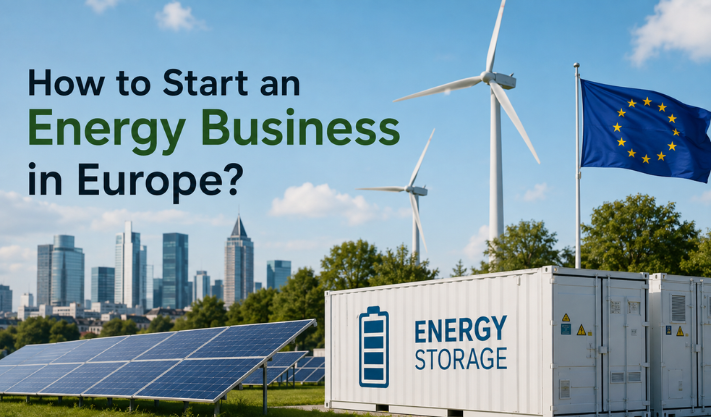
How to Start an Energy Business in Europe? A Complete Guide
Europe’s energy sector is rapidly changing because of renewable energy, electrification, battery storage, energy efficiency, smart grids, EV charging, and other clean-energy technologies. This transformation is creating opportunities for entrepreneurs, investors, technology companies, manufacturers, consultants, and energy-service providers.
But how do you start an energy business in Europe?
The answer depends on your specific energy activity, the European country you choose, your investment budget, business structure, and the licences or permits required for your operations.
This guide explains the key steps, costs, business opportunities, legal requirements, and challenges involved in starting an energy business in Europe.
1. Is Europe a Good Place to Start an Energy Business?
Yes, Europe is an attractive market for energy businesses, particularly in renewable energy, energy storage, energy efficiency, EV charging, smart-grid technology, and clean-energy services.
Businesses can participate in different parts of the energy value chain without necessarily owning large power-generation assets.
Popular opportunities include:
- Solar energy
- Wind-energy services
- Battery energy storage
- Energy efficiency
- EV charging
- Energy consulting
- Energy management
- Smart-grid technology
- Energy software
- Clean-energy equipment
- Renewable-energy project development
- Low-carbon heating
- Hydrogen-related services
The best approach is to identify a specific customer problem and build an energy solution around it.
2. What Energy Business Can You Start in Europe?
You can start several types of energy businesses depending on your expertise, investment capacity, target customers, and regulatory requirements.
Renewable Energy Businesses
- Solar installation
- Solar maintenance
- Wind-energy services
- Renewable-energy project development
- Renewable-energy consultancy
- Renewable-energy engineering
Energy Service Businesses
- Energy audits
- Energy-efficiency consulting
- Energy management
- Building energy services
- Sustainability consulting
Energy Technology Businesses
- Energy-management software
- AI energy optimization
- Battery-management software
- Smart-grid technology
- Renewable-asset monitoring
- Energy analytics
Energy Infrastructure Businesses
- EV charging
- Battery storage
- Microgrids
- Grid services
- Energy equipment supply
For small and medium-sized businesses, service-based models can be easier to enter than capital-intensive projects such as utility-scale solar farms or large battery-storage facilities.
3. Which European Country Is Best for an Energy Business?
There is no single best country in Europe for every energy business. The right country depends on your business model, target customers, technology, investment level, and regulatory requirements.
Before choosing a country, compare:
- Market demand
- Renewable-energy potential
- Electricity prices
- Grid infrastructure
- Customer location
- Labour availability
- Labour costs
- Taxation
- Company-formation requirements
- Energy licences
- Planning regulations
- Environmental rules
- Government incentives
- Supply-chain access
- Funding opportunities
For example, a solar company may prioritize solar resources and grid access, while an energy-software company may prioritize technology talent, investment, and customer demand.
Do not choose a country simply because company registration is cheap. Choose the market that fits your operating model.
4. Can a Foreigner Start an Energy Company in Europe?
Yes, foreign entrepreneurs can establish businesses in many European countries, but requirements vary by country, nationality, ownership structure, and business activity.
EU citizens generally have broad rights to establish businesses in other EU countries.
Non-EU entrepreneurs may need to consider:
- Business visas
- Residence permits
- Foreign-investment rules
- Tax registration
- Local business requirements
- Beneficial ownership registration
- Industry-specific regulations
Energy businesses involving critical infrastructure, electricity generation, networks, or strategic technologies may also face additional regulatory requirements.
5. What Is the Best Legal Structure for an Energy Business?
A limited-liability company is often a practical choice for an energy business, but the best structure depends on the country, ownership model, investment level, liability requirements, and expansion plans.
Possible structures include:
- Private limited company
- Public limited company
- Joint venture
- Sole proprietorship
- Branch office
- Subsidiary
- Cooperative
Businesses planning significant cross-border operations may also consider a European Company (SE) where the applicable requirements are met.
Before choosing a structure, consider:
- Liability protection
- Taxation
- Ownership
- Administration
- Investment requirements
- Future expansion
6. Does an Energy Business Need a Special Licence in Europe?
Sometimes. There is no single energy-business licence that applies across all European countries.
The required licences depend on what your company does and where it operates.
For example, an energy consultancy may have relatively straightforward requirements, while electricity generation, energy supply, grid infrastructure, construction, equipment installation, or environmental activities may require additional approvals.
Depending on the business, you may need:
- Company registration
- Business licence
- Energy-sector authorization
- Planning permission
- Environmental approval
- Building permits
- Grid-connection approval
- Electrical certification
- Technical approvals
- Health and safety compliance
Always confirm the requirements with the relevant national or regional authority before starting operations.
7. How Do You Start an Energy Business in Europe?
The basic process is to define your energy activity, research the market, choose the country, select a legal structure, register the company, obtain required licences, meet tax obligations, and begin operations.
Step 1: Define Your Energy Activity
Be specific about what you will sell or provide.
For example, “renewable energy company” is broad. “Commercial solar installation and maintenance” is much more specific.
Step 2: Research the Market
Identify:
- Target customers
- Competitors
- Market demand
- Pricing
- Customer problems
- Market gaps
Step 3: Choose the Country
Compare regulations, taxation, infrastructure, labour, customers, incentives, and operating costs.
Step 4: Choose the Legal Structure
Select a company structure that matches your ownership and investment plans.
Step 5: Register the Company
Complete the applicable company-registration process.
Step 6: Obtain Licences and Permits
Identify all energy, planning, environmental, technical, and operational approvals.
Step 7: Complete Tax and VAT Registration
Determine your applicable corporate-tax, VAT, payroll, and accounting obligations.
Step 8: Set Up Operations
Arrange your:
- Office
- Warehouse
- Equipment
- Vehicles
- Software
- Insurance
- Suppliers
Step 9: Hire Qualified Employees
Depending on your business, you may need engineers, technicians, project managers, sales professionals, or software specialists.
Step 10: Launch and Scale
Start serving customers, monitor your costs and revenue, and expand once the business model is proven.
8. How Much Does It Cost to Start an Energy Business in Europe?
There is no standard cost because different energy businesses require very different levels of investment.
| Energy Business | Relative Capital Requirement |
|---|---|
| Energy consultancy | Low |
| Energy audits | Low |
| Energy software | Low to medium |
| Solar installation | Medium |
| EV charging services | Medium |
| Battery installation | Medium to high |
| Solar project development | High |
| Utility-scale battery storage | High |
| Energy manufacturing | Very high |
Your total startup budget may include:
- Company registration
- Licences and permits
- Professional fees
- Office or warehouse
- Equipment
- Employees
- Insurance
- Vehicles
- Software
- Inventory
- Marketing
- Grid connection
- Working capital
Therefore, focus on total operational investment, not just company-registration costs.
9. Is Renewable Energy a Good Business Opportunity in Europe?
Yes. Renewable energy is one of the strongest energy-business opportunities in Europe.
Entrepreneurs can participate in:
- Solar installation
- Solar maintenance
- Wind-energy services
- Renewable-energy engineering
- Equipment supply
- Project development
- Operations and maintenance
- Renewable-energy software
- Energy monitoring
A smaller company does not necessarily need to build its own power plant. It can provide specialist services to renewable-energy developers, contractors, property owners, or commercial customers.
10. Is Energy Efficiency a Good Business in Europe?
Yes. Energy efficiency can be an attractive business because companies and property owners want to reduce energy consumption and operating costs.
Potential services include:
- Energy audits
- Building energy assessments
- HVAC optimization
- LED upgrades
- Energy-management systems
- Industrial energy optimization
- Smart-building technology
- Energy monitoring
- Sustainability consulting
Energy efficiency can be particularly suitable for SMEs because it generally requires less capital than large-scale generation or infrastructure projects.
11. Is EV Charging a Good Energy Business in Europe?
Yes. Growing EV adoption is increasing demand for reliable charging infrastructure and related services.
Potential business models include:
- Home EV charging
- Workplace charging
- Fleet charging
- Public charging stations
- Highway charging
- Commercial charging hubs
- EV charger installation
- Charger maintenance
- Charging software
- Smart charging
An integrated model combining EV charging, solar, battery storage, and energy management can create additional value for customers.
12. Is Energy Software a Good Business Opportunity in Europe?
Yes. Energy software is becoming increasingly important as energy systems become more digital, distributed, and complex.
Businesses can develop:
- AI energy-management platforms
- Energy forecasting software
- Battery optimization software
- Smart-grid platforms
- EV charging software
- Renewable-asset management systems
- Predictive-maintenance platforms
- Energy analytics
- Smart-building software
Energy software can be attractive because technology companies can potentially serve multiple customers without owning large physical energy infrastructure.
13. What Taxes and Compliance Requirements Apply to Energy Businesses?
Energy businesses may need to manage corporate tax, VAT, accounting, employment, customs, environmental compliance, insurance, and industry-specific reporting.
The exact requirements depend on the country and business activity.
Businesses operating across multiple European countries should pay particular attention to:
- Corporate tax
- VAT
- Cross-border transactions
- Payroll
- Customs
- Invoicing
- Accounting
- Environmental obligations
- Industry-specific reporting
Because European tax and regulatory systems differ between countries, professional legal and tax advice can be valuable before making a significant investment.
14. What Are the Biggest Mistakes to Avoid?
The biggest mistake is assuming that every European country follows the same rules for energy businesses.
Avoid these common mistakes:
- Choosing a country only because it is cheap.
- Selecting an overly broad business activity.
- Assuming one licence covers all energy services.
- Ignoring environmental approvals.
- Underestimating grid-connection requirements.
- Starting operations before obtaining required permits.
- Failing to plan for VAT and tax obligations.
- Underestimating working capital.
- Hiring unqualified technical staff.
- Entering the market without a clear customer segment.
- Failing to arrange appropriate insurance.
FAQs
What is the best energy business to start in Europe?
Solar installation, energy efficiency, EV charging, energy consultancy, battery services, energy software, and renewable-energy equipment supply can all be attractive opportunities, depending on the country and target market.
Can foreigners start an energy company in Europe?
Yes. Many European countries allow foreign entrepreneurs to establish businesses, subject to corporate, immigration, tax, ownership, and industry-specific requirements.
How much capital is needed to start an energy business in Europe?
There is no fixed amount. An energy consultancy or software company may require relatively little capital, while renewable-energy projects, manufacturing, and infrastructure businesses can require substantial investment.
Do you need an energy licence in Europe?
It depends on the country and activity. Regulated activities such as electricity generation, energy supply, infrastructure, and certain installation services may require additional licences and permits.
What is the best energy industry for the future in Europe?
Renewable energy, battery storage, energy efficiency, EV charging, grid modernization, electrification, and energy technology offer strong long-term opportunities.
Is renewable energy profitable in Europe?
It can be profitable, but profitability depends on technology, location, financing, energy prices, regulation, project size, and the business model.
What Is the Best Way to Start an Energy Business in Europe?
The most effective approach is to follow a clear sequence:
Choose a specific energy problem → identify your target customer → select the right European market → research regulations → establish the company → obtain licences → build your team and technology → launch → scale.
Instead of starting with the broad idea of an “energy company,” focus on a specific niche such as commercial solar installation, battery management, EV charging, energy-efficiency consulting, renewable-energy equipment, or energy software.
Final Answer
Europe offers significant opportunities for energy entrepreneurs, especially in renewable energy, energy storage, energy efficiency, EV charging, smart grids, and energy technology.
However, Europe is not one single licensing jurisdiction. The appropriate country, legal structure, permits, tax treatment, and operating requirements depend on your specific business model.
The smartest strategy is to define your exact energy activity first and then choose the European country that best matches your customers, technology, investment budget, infrastructure, and regulatory requirements.
Also Read:-
How Can Leaders Use AI to Reduce Operational Risks?
What Should Beginners Know About the UK Stock Market?
EU Business Investment Falls to 11-Year Low