
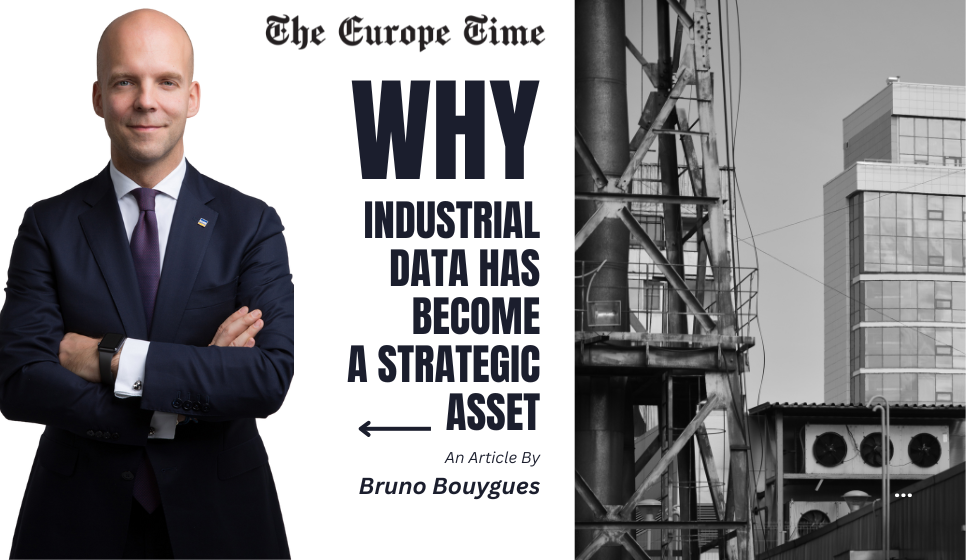
By Bruno Bouygues, CEO of GYS
Data Is the New Power in Industry
For many years, industrial success depended on factories, machines, scale, and efficiency. Today, one new factor is shaping long-term competitiveness: industrial data.
Modern industrial transformation is no longer only about better machines or more automation. Data itself has become a strategic asset. When collected, organized, and analysed correctly, data helps companies improve performance, reliability, and decision-making across the entire life of their equipment.
Yet, despite its importance, industrial data remains one of the most underused resources in manufacturing.
The Hidden Value of Industrial Machine Data
Every industrial machine generates huge amounts of data every day. A single production line can create terabytes of data daily. Most of this data is never used.
The problem is not a lack of data. The problem is the lack of:
- Clear data strategy
- Proper data architecture
- Strong data governance
At GYS, every welding cycle, charging curve, electrical variation, and diagnostic signal contains valuable information. But data alone has no value unless it is properly managed.
“Data should never be treated as machine exhaust. It deserves the same engineering discipline as hardware.”
From Raw Data to Useful Intelligence
To create value, industrial data must be:
- Reliably captured
- Structured in a consistent way
- Analyzed within real operating conditions
This is where proprietary software and artificial intelligence (AI) become essential. Their role is not to replace people, but to turn raw data into clear operational insight.
In the past, industrial data was stored only for limited diagnostics or quality checks. Today, it must support strategic decisions, not just technical ones.
Why GYS Changed Its Industrial Data Strategy
GYS produces nearly 2,000 machines per day and serves customers in more than 130 countries. Building strong machines is no longer enough.
The real challenge now is to:
- Understand how machines are used in real conditions
- Learn from different industries, climates, and usage patterns
- Transform machine usage into long-term intelligence
“The challenge is not creating more data, but structuring it so better decisions can be made faster.”
Artificial Intelligence Works Only with Quality Data
AI is often seen as a solution on its own. In industrial environments, this is misleading.
Without:
- Clean data
- Harmonized formats
- Proper context
AI produces weak and unreliable results.
When used correctly, however, AI becomes a powerful accelerator. It helps:
- Detect patterns humans cannot easily see
- Predict equipment failures
- Optimize manufacturing and maintenance
This leads to predictive maintenance, which reduces downtime, extends machine life, and lowers operating costs.
“AI should not replace experience. It should multiply it.”
Predictive Maintenance: From Reaction to Prevention
With advanced analytics:
- Companies move from fixing problems to preventing them
- Decisions become proactive instead of reactive
- Operators and engineers gain better visibility and confidence
Predictive maintenance is one of the most practical examples of data-driven industrial transformation.
The Importance of Industrial Data Architecture
One major challenge in industrial data is system fragmentation. Machines from different generations use different standards, formats, and protocols.
This makes large-scale data analysis very difficult.
At GYS, the focus is on:
- Local data processing
- Secure data flows
- Full control over sensitive information
In industrial environments, architecture often matters more than algorithms. Without a strong data foundation, advanced analytics cannot succeed.
Machine Data as a Long-Term Competitive Advantage
Companies that master machine data gain:
- Deep understanding of real-world performance
- Knowledge of equipment limits and improvement areas
- Ability to optimize machines over time
For GYS, controlling hardware, software, operating systems, analytics, and data is a long-term strategic commitment, not a short-term tactic.
Industrial investments last decades. Data systems must be reliable and compatible over 10 to 20 years.
From Descriptive to Predictive and Prescriptive Analytics
Industrial analytics has evolved:
- Descriptive – What happened
- Predictive – What will happen
- Prescriptive – What should be done
The most advanced systems allow machines to learn from thousands of similar machines operating worldwide. Each usage cycle adds knowledge to a shared intelligence base.
This evolution requires:
- Strong data governance
- Continuous model validation
- Operational feedback loops
Why Data-Driven Industry Is No Longer Optional
Industry 4.0 and advanced analytics deliver real results:
- Reduced downtime
- 15–30% increase in labor productivity
- Over 10% of operating profit driven by analytics in leading companies
Data alone does not guarantee success. But without data, companies lose control over performance, margins, and independence.
In a world of rising energy, labor, and capital costs, data is one of the last internal levers industrial leaders control.
Conclusion: Data Determines the Future of Industry
Companies that turn data into operational intelligence build advantages that competitors struggle to copy.
Those who delay will not just fall behind. They risk becoming irrelevant.
“Structuring machine data today means securing the ability to decide and innovate tomorrow. It separates companies that shape their future from those shaped by it.”
Also Read:
European Lifestyle Brands Leverage E-Commerce Growth
France Fashion Industry Growth: Top Brands to Watch in 2026
Gender Pension Gap in Europe: Women Earn Much Less