
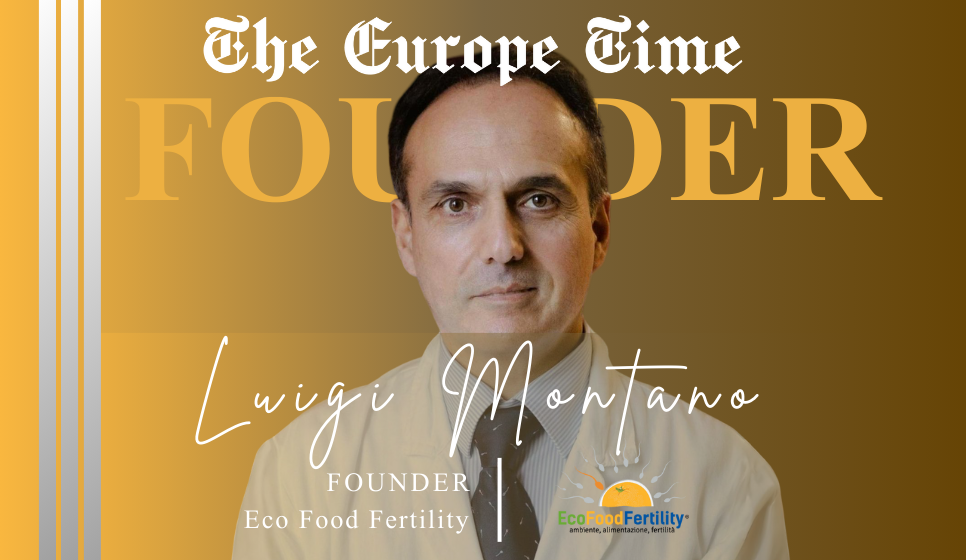
Luigi Montano Interview
Dr. Luigi Montano is a medical doctor specialized in Urology and Andrology, a PhD researcher in Evolutionary Biology and Ecology, and a leading voice in environmental and preventive medicine. As Head of the Andrology Unit and founder of the EcoFoodFertility project, his work bridges clinical practice, scientific research, and public health policy. By positioning human fertility—particularly seminal fluid as an early biological indicator of environmental damage, Montano advances innovative models of primary prevention, resilience, and health surveillance. His research highlights the deep interconnection between pollution, nutrition, lifestyle, and long-term human health, with implications not only for reproductive well-being but for future generations and sustainable public health systems worldwide.
Professional Background and Mission
We started the interview by asking, “How would you introduce yourself and explain the core mission behind your work today?”
Luigi Montano replied, “I am a medical doctor specialized in Urology and Andrology, with National Scientific Qualification as Associate Professor of Urology and a PhD in Evolutionary Biology and Ecology. I am a former President of the Italian Society of Human Reproduction. The main focus of my professional and research activity is environmental and lifestyle medicine and preventive strategies, with the aim of understanding how environmental pollution, nutrition, and daily habits influence human health long before disease becomes clinically evident. As Head of the Andrology Unit and of the Environmental Pathology and Lifestyle Medicine Service at the Salerno Local Health Authority, and as founder of the EcoFoodFertility project, I work at the intersection of clinical practice and research. In a world where environmental pressure and unhealthy lifestyles and behaviors have long been increasingly and negatively affecting overall health—starting with reproductive health—my goal is to provide new models of primary prevention and resilience, considering fertility indicators as key tools for safeguarding present and future public health. Assessing very young individuals during the most fertile phase of their lives, not only allows for the early identification of the first signs of health damage caused by environmental factors and lifestyle choices factors that primarily impact the reproductive system, a true “sentinel organ”, but also enables education aimed at recognizing harmful exposures and initiating health promotion pathways. This approach seeks to reduce not only the rising rates of infertility, but also the burden of future chronic-degenerative diseases in adulthood and in subsequent generations, given the well-documented transgenerational effects increasingly reported in the scientific literature.”
A Personal Journey Shaped by Environmental Crisis
The Europe Time: What personal experiences shaped your focus on environmental and reproductive health?
Luigi Montano replied, “My scientific path is deeply connected to my personal history. I was born and grew up in Acerra, the epicenter of an area recognized as emblematic of Italy’s environmental and public health crisis, sadly known as the “Land of Fires” (Terra dei Fuochi”). The increased incidence of several chronic-degenerative diseases—such as cancer, even among very young individuals—has profoundly affected me and led me to question how we might identify, and develop scientifically more robust models to recognize, the earliest signs of environmentally induced damage to public health, along with corresponding active measures of prevention and resilience. This was especially pressing given that classical epidemiological risk assessment models often entail substantial uncertainty. In particular, the observation of pathological outcomes and their passive recording—through tools such as cancer registries, which are certainly useful for health planning when data are made available in a timely manner—did not, in my view, adequately address the urgent need for active prevention in populations living in areas like mine and in other regions exposed to high environmental pressure. I felt the need to develop a new study framework capable of enabling early and proactive public health protection actions, especially for new and future generations, with the aim of reducing the “temporal” gap in health risk assessment and management precisely in those areas most heavily burdened by environmental stressors. This motivation led me to investigate how environmental factors “silently” influence our biology, particularly reproductive biology, which often manifests damage earlier than other physiological systems.”
The Vision behind EcoFoodFertility
The Europe Time: What is EcoFoodFertility, and what was your vision behind creating it?
Luigi Montano replied, “EcoFoodFertility is a research project that I conceived to investigate how, and to what extent, environmental pollution, food quality, and lifestyle influence overall health, considering human fertility as an early and predictive indicator of environmental and general health, as well as to identify measures capable of preventing and mitigating the effects of environmental contaminants. My vision was to move beyond isolated observations and outcome-based analyses, and to build a scientific model capable of measuring environmental impact at an early stage through highly sensitive biological biomarkers. Fertility, particularly male fertility and, more specifically, seminal fluid, regarded as a “Sentinel Semen”, is extremely sensitive to environmental changes and lifestyle factors and provides information of great scientific and clinical value. Today, the project brings together clinicians and researchers from multiple disciplines within a One Health framework, forming an Interdisciplinary Network for Environmental and Reproductive Health (https://www.ecofoodfertility.it/rete-nazionale/ricercatori) across several regions of Italy. In recent years, this network has been expanding beyond national borders through international collaborations and researchers, supported by multiple active research lines and numerous international publications (https://www.ecofoodfertility.it/chi-siamo/pubblicazioni-scientifiche). The project also operates according to the principles of Citizen Science, thanks to strong collaboration with local communities—including schools and associations—always striving to build a relationship of trust between science and the communities involved. Based on the results achieved, the EcoFoodFertility biomonitoring model is increasingly emerging as an innovative tool for health surveillance, primary prevention, and resilience in exposed populations, positioning reproductive health as a key indicator of environmental conditions and public health.”
Early Warning System for Environmental Damage
The Europe Time: Why do you describe semen as a “sentinel” of environmental health?
Luigi Montano replied, “I describe seminal fluid as a sentinel fluid because it reacts very rapidly to environmental and lifestyle-related stressors. Pollutants such as heavy metals, pesticides, and, more broadly, endocrine-disrupting chemicals can alter sperm concentration, motility, morphology, and DNA integrity, often before clinical symptoms appear. In many apparently healthy young men, seminal alterations reveal hidden biological damage caused by environmental exposure. This makes semen analysis a powerful early warning tool. By studying reproductive parameters, we can identify environmental risks at an earlier stage, intervene promptly, and protect not only fertility but also long-term overall health, both at the individual and population levels.”
Nutrition as a Tool for Prevention and Resilience
The Europe Time: How important is nutrition in protecting fertility and overall health?
Luigi Montano replied, “Nutrition plays a fundamental protective role in my research. Although we cannot immediately eliminate environmental pollution, we can influence how our bodies respond to it. I strongly advocate a Mediterranean-style diet based on organic, clean, seasonal, and minimally processed foods which, in addition to being free from pesticide residues, are rich in phytochemicals with high antioxidant and detoxifying capacity. These compounds can help reduce pollutant burden and/or modulate their negative effects on health, thereby promoting a form of environmental and human resilience (a “remediation of the polluted human body”).This type of diet helps counteract pollutant-induced oxidative stress, supports hormonal balance and reproductive function, and enhances detoxification processes. Food is not merely fuel, but a daily tool for prevention. Choosing healthier foods also means supporting sustainable agriculture and reducing environmental contamination. In this way, nutrition becomes a bridge between individual health, environmental responsibility, and long-term social well-being.”
From Reproductive Health to Public Health Strategy
The Europe Time: How does your work connect fertility research to broader public health issues?
Luigi Montano replied, “Although fertility is central to my work, its implications extend far beyond reproduction. Reproductive health often reflects early biological damage that may later manifest as chronic diseases, metabolic disorders, or cancer. By identifying these signals at an early stage, medicine can be redirected toward prevention rather than late-stage intervention. My research encourages healthcare systems to consider environmental exposure as an integral component of routine clinical assessment. This approach reshapes the conceptualization of public health by highlighting the responsibility of institutions to monitor environmental risks and to inform communities. Fertility is not a private issue; it is a collective indicator of social and environmental health.”
Driving Scientific Change and Influencing Policy
Lastly we asked, “What impact do you hope your research will have on science and policy?”
“I hope that my research will contribute to a cultural and scientific shift oriented toward prevention, resilience, and responsibility. Through publications, collaborations, and public communication, we are already providing concrete evidence linking environmental pollution to human health. My objective is to encourage policymakers to adopt innovative population monitoring and surveillance strategies, with a particular focus on very young individuals, in order to prevent—or at least reduce—the burden of future diseases. For this reason, we place strong emphasis on reproductive biomarkers as early indicators of biological damage, alongside environmental measurements. I also aim to increase public awareness by empowering citizens to understand environmental risks and the importance of lifestyle choices. Ultimately, I believe that science already possesses the appropriate tools to serve society and protect present and future generations by ensuring health, environmental integrity, and sustainability dimensions that must always be regarded as deeply interconnected priorities.” Luigi Montano concluded
Connect with Luigi Montano on LinkedIn
Also Read
Petar Milenković: MISPAYWAY Expands Operations
Paul Nicholls Redefines Global Waste with Tech & Circular
Giorgio Karhausen: Engineering Sustainable Finance