
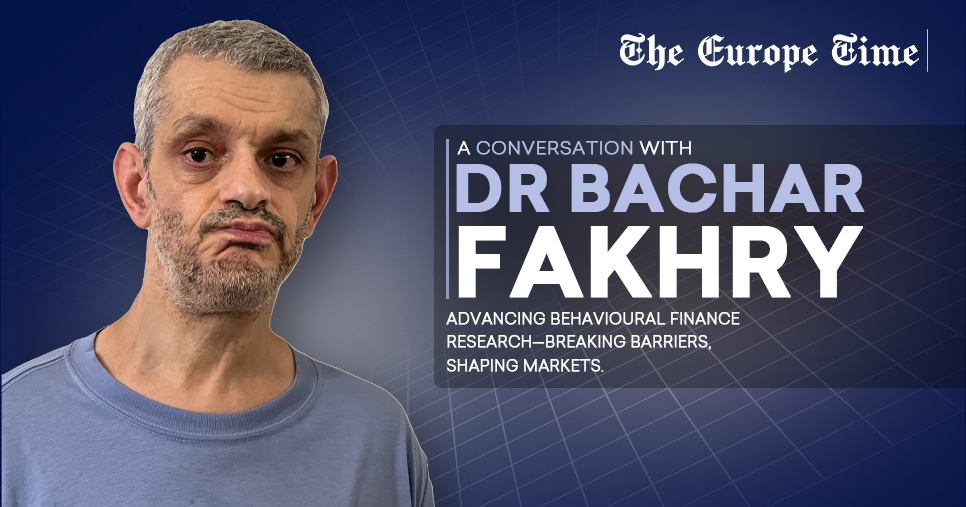
Dr. Bachar Fakhry Interview
Dr. Bachar Fakhry is a researcher in financial economics whose work explores the intersection of behavioural finance, market efficiency, and crisis-driven investor psychology. His research critically evaluates traditional assumptions such as the Efficient Market Hypothesis (EMH), while providing evidence that real-world markets are shaped by sentiment, cognitive bias, and emotional reactions, especially during periods of uncertainty such as Brexit and the COVID-19 pandemic. By extending behavioural finance into the growing domain of neural economics, Fakhry contributes to a deeper understanding of how decision-making is influenced not only by information, but also by neurological triggers linked to fear, stress, and risk perception. His studies offer important implications for policymakers, institutional investors, and academics seeking to better interpret market volatility and behavioural cycles across both equity and housing markets.
Reconciling Behavioural Finance with the Efficient Market Hypothesis
The Europe Time: How does your research reconcile behavioural finance with the traditional Efficient Market Hypothesis (EMH)?
Dr. Bachar Fakhry replied:
“My research examines the fundamental tension between behavioural finance and the Efficient Market Hypothesis (EMH). Traditional EMH assumes that markets fully reflect all available information in asset prices. However, empirical evidence shows significant volatility and investor over-/under-reaction following major events, indicating that market prices often deviate from information efficiency.
This has been a core theme in my work, from literature reviews critically assessing EMH to empirical studies showing that investor psychology and behavioural responses are essential to understanding real market pricing dynamics. Hence, I argue that models of asset pricing must integrate psychological biases and cognitive reactions alongside information flow to more accurately reflect how markets behave during crises and structural change.”
Market Behaviour During Brexit and COVID-19 Shocks
The Europe Time: Your work frequently examines market reactions to extreme events like Brexit and COVID-19. What patterns have you observed, and what are the implications for how markets function in such periods?
Dr. Bachar Fakhry replied:
“Research on extreme events consistently shows that market participants do not behave rationally in the classic EMH sense during shocks. For example:
- Brexit: Market responses exhibited heightened volatility and sentiment-driven adjustments, rather than purely information-based pricing. The uncertainty amplified behavioural biases like loss aversion and trend extrapolation.
- COVID-19: Our uncertainty behavioural factor model revealed that the pandemic triggered global cognitive and emotional reactions, causing investors to overestimate risks and underreact to stabilising signals.
These patterns suggest markets are deeply influenced by neuropsychological responses to fear, uncertainty and sentiment, especially under stress. This strongly supports integrating behavioural finance tools in market analysis and policy response strategies during crises.”
Why Neural Economics Matters for Modern Financial Research
The Europe Time: What motivated your focus on neural economics, and how does it expand conventional behavioural finance research?
Dr. Bachar Fakhry replied:
“Neural economics is an extension of behavioural economics that links brain processes with economic decision-making. Traditional behavioural finance identifies cognitive biases but often stops at psychological descriptions. Neural economics goes deeper by trying to map neurological mechanisms, such as how stress, fear or reward processing in the brain affects investment decisions during uncertainty or crisis.
My motivation stems from the realization that cognitive biases alone don’t fully explain investor behaviour. Understanding the underlying neural triggers offers predictive power and richer explanation of market dynamics. This bridges economics, psychology and neuroscience to develop more robust models of behaviour under extreme financial conditions.”
Behavioural Drivers in Housing Markets and Policy Implications
The Europe Time: What lessons should policymakers and institutional investors take from your research on the housing market’s behavioural drivers?
Dr. Bachar Fakhry replied:
“The housing market is often treated in standard economic models as driven by fundamentals, income, interest rates, supply and demand. Yet our review of behavioural factors indicates consistent heuristic-based decision making, where buyers and sellers rely on simplifications, emotions and biases. These influences affect pricing, demand cycles and even policy outcomes.
For policymakers, this means traditional tools like interest rate adjustments or supply incentives must be paired with understanding how agents psychologically perceive risk and value. For institutional investors, long-term strategies should account for behavioural cycles that can drive overpricing or underpricing in housing bubbles. This holistic view leads to better forecasting and risk management.”
Future Research Frontiers in Behavioural and Financial Economics
The Europe Time: Looking forward, what emerging areas of research in behavioural and financial economics excite you the most?
Dr. Bachar Fakhry replied:
“Several emerging directions are particularly promising:
- Behavioural Neurofinance: Deepening the neural basis of economic decisions, especially using biometric or neuroimaging data.
- Machine Learning and Behavioural Patterns: Leveraging AI to detect and model human-driven biases in real-time market data.
- Post-Crisis Market Adaptation: Understanding how repeated global shocks such as pandemics, geopolitical events, and climate stress reshape investor heuristics and long-term market structures.
- Policy-Behaviour Interfaces: Evaluating how policy communications and incentive designs influence collective market sentiment and expectations.
These areas promise to break new ground in understanding not just how markets operate, but how economic systems learn and evolve amid behavioural feedback loops.”
Conclusion
Through his work on market shocks, behavioural volatility, and the emerging field of neural economics, Dr. Bachar Fakhry provides a forward-looking academic framework for interpreting how investors truly behave under uncertainty. His research highlights that market movements cannot be fully explained by information efficiency alone, and that psychology, alongside neurological response patterns, must be integrated into future financial models, regulatory strategies, and institutional investment planning.
Backlinks / Research Profiles
Connect with Dr. Bachar Fakhry and explore his publications here:
- Academia: https://bacharfakhry.academia.edu/
- ResearchGate: https://www.researchgate.net/profile/Bachar-Fakhry?ev=hdr_xprf
Also Read
Goran Makeski’s Artistic Journey
Luigi Montano on EcoFood, fertility, and preventive care
Petar Milenković: MISPAYWAY Expands Operations