
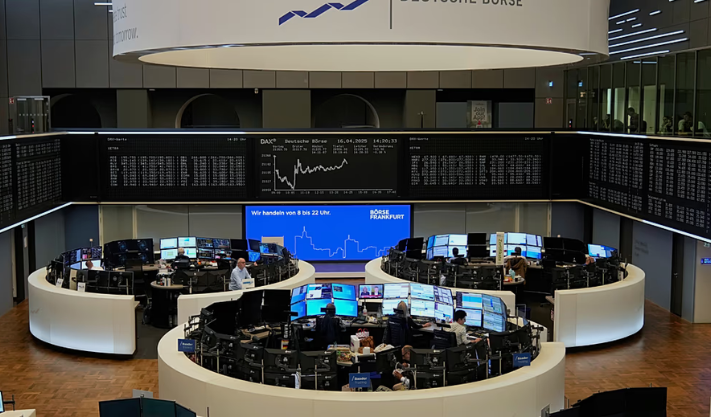
European markets fall, gold rises as US threatens Greenland tariffs
European stock markets opened lower on Monday after US President Donald Trump threatened new tariffs on several European countries over Greenland. The US said it might buy Greenland, a semi-autonomous Danish territory, and warned eight European nations to support the plan—or face tariffs.
At 10 a.m. CET, France’s CAC 40 was down 1.28%, Germany’s DAX fell 1.02%, and the UK’s FTSE 100 dropped 0.27%. Spain’s IBEX 35 lost 0.59%, Italy’s FTSE MIB slid 1.43%, and the broader STOXX 600 index fell 0.87%.
The US announced on Saturday that Denmark, Norway, Sweden, France, Germany, the UK, the Netherlands, and Finland would face a 10% tariff on exports to the US starting 1 February if they did not back the Greenland plan. If there is no agreement by June, tariffs could rise to 25%.
European leaders have strongly supported Greenland’s self-rule and Denmark’s sovereignty. They are now discussing how to respond. Some options include imposing retaliatory tariffs on €93 billion of US goods, a plan considered but dropped last year, or using an anti-coercion tool to punish countries that try to force policy changes.
The threat affected European companies immediately. Car stocks dropped sharply, with the STOXX Europe 600 Automobiles & Parts Index falling more than 2% to a 52-week low. BMW shares fell 4.10%, Volkswagen lost 3.43%, and Volvo dropped 2.21%. Luxury goods companies also suffered, with the STOXX Europe Luxury 10 index down almost 3%.
Meanwhile, investors moved money into safe assets. Gold rose over 1.66% to nearly $4,700 an ounce, and silver climbed past $94. Cryptocurrencies and other risky investments lost appeal. Defence stocks, however, benefited. The STOXX Europe Aerospace & Defence Index rose 0.49%, with Thales up 2.41%, Rheinmetall up 2.89%, Leonardo up 3.05%, and BAE Systems up 1.77%.
Asian markets mostly fell as well. Japan’s Nikkei 225 dropped 0.65%, Hong Kong’s Hang Seng lost 1.05%, and Australia’s S&P/ASX 200 slipped 0.33%. South Korea’s Kospi and China’s SSE Composite Index, however, ended higher. US markets were closed for Martin Luther King Day, but S&P futures fell 1.18%. The US dollar also weakened 0.21% against the euro by 10 a.m. CET.
Analysts said the Greenland dispute adds uncertainty for European industries. “The flare-up over Greenland and the threat of tariffs are unwelcome for Europe, especially now that industrial confidence was improving after last year’s trade tensions,” said ING analysts. They added that the situation could push European governments to strengthen domestic demand and push through reforms like the Savings and Investment Union to help capital markets compete with the US.
Investors will also watch the World Economic Forum in Davos this week. President Trump is scheduled to speak on Wednesday, and any announcements could further affect global markets.
Also Read:
Germany’s Real Estate Funds Gain Popularity Among Investors
Italy’s Small Businesses Thrive Amid Economic Reforms
Can Europe’s Military Spending Boost Economic Growth?