
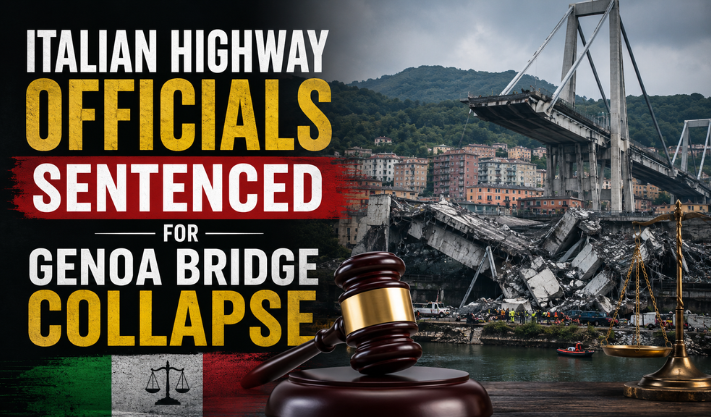
The conviction of Italian motorway officials over the Genoa bridge collapse marks one of the most significant legal developments in modern European infrastructure history. The disaster not only claimed dozens of lives but also triggered widespread reforms in bridge safety, maintenance oversight, and infrastructure accountability across Italy.
What happened in the Genoa bridge collapse?
The Genoa bridge collapse occurred on 14 August 2018, when a large section of the Morandi Bridge in Genoa, Italy, suddenly gave way during heavy rain.
Vehicles traveling across the bridge fell approximately 45 meters (148 feet) onto railway tracks, buildings, and roads below.
The tragedy resulted in:
- 43 people losing their lives
- Dozens of injuries
- Hundreds of residents displaced
- Significant damage to nearby infrastructure
The collapse shocked Italy and drew international attention because the bridge was one of the country’s major transportation routes.
What was the Morandi Bridge?
The Morandi Bridge, officially called the Polcevera Viaduct, was an important motorway bridge connecting northern Italy with southern France and the Italian Riviera.
It was:
- Designed by engineer Riccardo Morandi
- Opened in 1967
- Considered an engineering landmark
- Used by thousands of vehicles every day
Over time, experts raised concerns about the bridge’s aging concrete structure and increasing traffic loads.
Why were Italian motorway officials convicted?
Italian motorway officials were convicted because investigators concluded that several individuals responsible for managing and maintaining the bridge failed to address known structural problems.
According to court findings, officials were found guilty of negligence related to infrastructure maintenance and safety oversight.
The convictions centered on allegations that:
- Warning signs were ignored.
- Maintenance work was delayed.
- Inspection reports underestimated risks.
- Safety recommendations were not fully implemented.
The court determined that these failures contributed to the collapse.
Who was responsible for maintaining the bridge?
At the time of the disaster, the bridge was operated by Autostrade per l’Italia (ASPI) under a motorway concession agreement.
The company was responsible for:
- Routine inspections
- Structural maintenance
- Safety monitoring
- Repair planning
- Infrastructure management
The disaster prompted extensive investigations into the company’s maintenance practices.
What did investigators discover?
The investigation lasted several years and included engineers, prosecutors, technical experts, and infrastructure specialists.
Investigators examined:
- Maintenance records
- Inspection reports
- Internal company communications
- Engineering assessments
- Structural calculations
Authorities concluded that deterioration in critical components had progressed over many years.
The investigation suggested that opportunities to intervene earlier may have prevented the tragedy.
What were the court’s findings?
The court ruled that multiple officials failed to fulfill their legal responsibilities regarding public safety.
The judgment emphasized that infrastructure operators have a duty to identify risks, conduct proper maintenance, and act promptly when structural concerns emerge.
While different defendants received different legal outcomes depending on their roles, the ruling reinforced the principle that negligence in public infrastructure management can carry serious criminal consequences.
Why is this case important?
The Genoa bridge collapse became a defining moment for infrastructure safety across Europe.
Its importance includes:
- Greater accountability for infrastructure operators
- Stronger bridge inspection standards
- Increased investment in maintenance
- Public awareness about aging infrastructure
- New engineering safety procedures
Many countries reviewed their own bridges following the disaster.
Did Italy change its infrastructure policies?
Yes.
Following the collapse, Italy introduced significant changes aimed at improving infrastructure safety.
These reforms included:
More frequent inspections
Authorities increased inspection schedules for bridges and viaducts.
Better monitoring technology
Engineers adopted modern structural monitoring systems capable of detecting movement and deterioration earlier.
Increased investment
The Italian government committed billions of euros toward repairing and upgrading aging roads and bridges.
Improved oversight
Greater regulatory supervision was introduced to ensure concession operators comply with safety requirements.
Was a new bridge built?
Yes.
The damaged Morandi Bridge was demolished after the collapse.
A replacement bridge—the Genova San Giorgio Bridge—was designed by renowned architect Renzo Piano.
The new bridge:
- Opened in 2020
- Features modern engineering standards
- Includes advanced structural monitoring
- Represents Genoa’s recovery from the tragedy
Today, it serves as an important transportation link for northern Italy.
How did the bridge collapse affect Italy?
The disaster had significant social, economic, and political consequences.
Its impact included:
Human impact
Families lost loved ones, and survivors experienced lasting emotional trauma.
Economic disruption
The bridge served as a major transportation corridor, and its loss disrupted trade, tourism, and local businesses.
Political debate
Questions arose regarding privatization, infrastructure funding, and government oversight.
Public trust
Many Italians demanded stronger accountability from both public institutions and private infrastructure operators.
What lessons can other countries learn?
The Genoa tragedy demonstrates that infrastructure requires continuous monitoring rather than occasional repairs.
Important lessons include:
- Never delay structural maintenance.
- Act immediately on engineering warnings.
- Use modern monitoring technology.
- Maintain transparent inspection records.
- Invest in preventive maintenance instead of emergency repairs.
These lessons are now influencing infrastructure policies worldwide.
Why do bridge inspections matter?
Bridge inspections help engineers identify problems before they become dangerous.
Regular inspections can detect:
- Concrete deterioration
- Corrosion
- Cable damage
- Structural movement
- Water infiltration
- Foundation issues
Early detection significantly reduces the risk of catastrophic failures.
What technologies are now used to monitor bridges?
Modern bridges increasingly use digital monitoring systems.
These include:
- Structural health sensors
- Fiber-optic monitoring
- GPS movement tracking
- Drone inspections
- AI-assisted image analysis
- Predictive maintenance software
These technologies allow engineers to detect small changes before they become major structural risks.
How has this case influenced engineering practices?
Engineering organizations around the world have placed greater emphasis on:
- Risk-based inspections
- Lifecycle asset management
- Independent safety audits
- Data-driven maintenance planning
- Digital infrastructure monitoring
Many engineering firms now combine traditional inspections with real-time monitoring systems.
Could similar bridge collapses happen elsewhere?
Unfortunately, aging infrastructure exists in many countries.
However, regular inspections, timely repairs, adequate funding, and strict engineering standards greatly reduce the likelihood of similar disasters.
Experts agree that prevention is considerably less costly than rebuilding after a catastrophic failure.
What does the conviction mean for future infrastructure projects?
The convictions send a clear message that infrastructure operators and public officials may be held legally accountable if negligence contributes to preventable disasters.
Future projects are expected to place greater emphasis on:
- Safety-first decision-making
- Transparent maintenance reporting
- Independent engineering reviews
- Continuous monitoring
- Long-term infrastructure investment
This approach aims to protect both public safety and public confidence.
When did the Genoa bridge collapse happen?
The Morandi Bridge collapsed on 14 August 2018 in Genoa, Italy.
How many people died?
A total of 43 people lost their lives in the disaster.
Why were motorway officials convicted?
They were convicted after the court found negligence in bridge maintenance, inspections, and safety oversight that contributed to the collapse.
What bridge replaced the Morandi Bridge?
The Genova San Giorgio Bridge, opened in 2020, replaced the collapsed structure.
What changed after the collapse?
Italy strengthened bridge inspections, increased infrastructure investment, adopted advanced monitoring technologies, and enhanced regulatory oversight.
Why is this case significant?
It highlights the importance of infrastructure maintenance, public safety, and legal accountability for those responsible for managing critical public assets.
Conclusion
The convictions of Italian motorway officials over the Genoa bridge collapse represent a landmark moment in infrastructure accountability. Beyond the courtroom, the case has reshaped how governments, engineers, and infrastructure operators approach bridge safety and maintenance. It underscores the need for proactive inspections, timely repairs, transparent oversight, and the use of modern monitoring technologies to protect lives. As nations around the world confront the challenges of aging infrastructure, the lessons from Genoa continue to influence policies designed to prevent future tragedies and build safer transportation networks.